Advances in Engineering Advances in Engineering features breaking research judged by Advances in Engineering advisory team to be of key importance in the Engineering field. Papers are selected from over 10,000 published each week from most peer reviewed journals.

Applied Organometallic Chemistry, Volume 27, Issue 6, pages 328–336, 2013.
Paweł Horeglad, Anna Litwińska, Grażyna Z. Żukowska, Dominik Kubicki, Grzegorz Szczepaniak, Maciej Dranka, Janusz Zachara.
Faculty of Chemistry, University of Warsaw, Warsaw, Poland and
Faculty of Chemistry, Warsaw University of Technology, Warsaw, Poland
Abstract
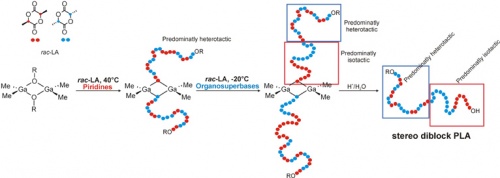
Stereoselective polymerization of rac-lactide is one of the most important issues as the properties of polylactide (PLA) depend strongly on its tacticity. There is, however, a paucity of catalysts that allow for easy switching between heteroselectivity and isoselectivity, which limits the synthesis of stereo copolymers of PLA and modification of polylactide properties. Dialkylgallium alkoxides activated by organosuperbases have been used as catalysts in the ring-opening polymerization of racemic lactide (rac-LA). The reaction of (S,S)-[Me2Ga(u-OCH(Me)CO2Me)]2 (1) with 1,8-diazabicyclo[5.4.0]undec-7-ene (DBU) or 7-methyl-1,5,7-triazabicyclo[4.4.0]dec-5-ene (MTBD) resulted in the formation of isoselective gallium species, highly active in the polymerization of rac-LA. DOSY (diffusion-ordered spectroscopy) NMR was indicative for the presence of dimeric gallium species. However, the structure of model monomeric gallium alkoxide Me2Ga(ON) (where ON is monoanionic bidentate ligand possessing organosuperbase functionality) shows that the presence of an organosuperbase may substantially weaken Ga−Oalkoxide−Ga bridges. The facile switch of stereoselectivity upon addition of organosuperbase to nonselective/heteroselective 1 allowed for the first time the synthesis of diblock polylactide comprised of isotactically and heterotactically enriched blocks. Copyright © 2013 John Wiley & Sons, Ltd.
Copyright © 2013 John Wiley & Sons, Ltd.
Additional Information
Dialkylgallium alkoxides can polymerize racemic lactide (rac-LA) in a living manner and with high stereoselectivity depending on the Lewis base added. This allowed, for the first time, for the synthesis of stereo diblock polylactide comprised of isotactically and heterotactically enriched blocks. Our finding gives new opportunities for the modification of structure and properties of biodegradable polymers based on polylactide (PLA).