Advances in Engineering Advances in Engineering features breaking research judged by Advances in Engineering advisory team to be of key importance in the Engineering field. Papers are selected from over 10,000 published each week from most peer reviewed journals.

Energy Policy 62 (2013):176–184. James W. Stoutenborough1, Shelbi G. Sturgess2, Arnold Vedlitz3
1. Department of Political Science, Idaho State University, 302 Graveley Hall, Pocatello, ID 83209, USA and
2. Smith & Harroff, Inc., Washington, D.C., USA and
3. Institute for Science, Technology and Public Policy, The Bush School of Government and Public Service, Texas A&M University, TAMU 4350, College Station, TX 77843-4350, USA.
Abstract
Nuclear energy was becoming increasingly popular as an alternative to air polluting fossil fuel technologies through the latter half of the 2000s. The tragic events of March 11, 2011 in Fukushima, Japan, appear to have instantly killed any momentum the nuclear industry had gained. While unfortunate, many argue that nuclear power is still a safe alternative and that the Fukushima disaster resulted from insufficient safety regulations in Japan, a problem that does not exist in the United States. This project examines U.S. public support for nuclear energy one year after the Fukushima tragedy, seeking to understand the influence of knowledge and risk perceptions on policy support. We evaluate public support for nuclear energy policy from several perspectives using risk and attitudinal measurements that are more specific than often found in the literature to obtain a greater understanding of the connection between policy and risk.
Significance Statement
Although there is still a lot of uncertainty regarding public support for nuclear energy in the United States, our analyses illustrate that a number of risk perceptions, attitudes, and knowledge predict support or opposition to nuclear policy. We would like to provide a substantive interpretation of five of these predictors – likely energy shortage, nuclear harmful for environment, meltdown risk, storage risk, and transportation risk. While the coefficient estimates indicate statistical significance, they can be difficult to interpret. We simulated the responses of 1000 individuals using predicted probabilities.
We begin with the substantive interpretations for the belief the US will face an energy shortage (Figure 1). As individuals believe the US will face an energy shortage, they are more likely to support nuclear energy. Specifically, when an individual reports a 0 for this likelihood, only 4 (out of 1000 simulated) are predicted to “strongly support” nuclear energy. However, when increased to 4, the number who “strongly support” increases to 21, a 425% increase. Conversely, those who believe nuclear energy is harmful to the environment were less likely to support nuclear policy. The simulation predicts that when this belief is set to 0, only 11 people will “strongly oppose” the policy. When this is increased to 4 (the highest point on the scale), the number who “strongly oppose” increases to 91. This represents a 727.27% increase.
Figure ( 1 )
The second set of simulations capture the substantive influence of the risk variables (Figure 2). Generally, those who perceive greater risk of meltdown and storage were less likely to support. Specifically, when risk is 0, 37 (meltdown) and 30 (storage) people are predicted to “strongly oppose.” When these risks are increased to 4, strong opposition increases to 80 (meltdown) and 66 (storage). These represent a 116.22% and 120% increase in strong opposition, respectively. Finally, the generalized ordered logit model revealed that those who perceive no risk to transportation were less likely to support nuclear policy, but those who perceive moderate to high levels of risk were more likely to support. Because of the nuance afforded by the analysis and the nature of this relationship, we will focus on predicted levels of “support.” When risk is set to 0, the simulation predicts that only 32 people will “support” nuclear policy. However, when this is increased to 4, “support” increases to 192. This represents a 500% increase in “support.”
Figure 1: Simulated Distribution of Nuclear Policy Support, by Likelihood of an Energy Shortage and the Belief that Nuclear Energy is Harmful for the Environment
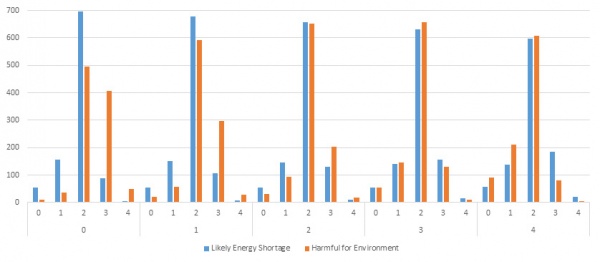
Note: Simulation out of 1000 stakeholders. Likely Energy Shortage increase from 0 = not at all likely, to 4 = extremely likely. Nuclear Harmful for Environment values increase from 0 = not at all harmful, to 4 = very harmful.
Figure 2: Simulated Distribution of Nuclear Policy Support, by Risk Perceptions
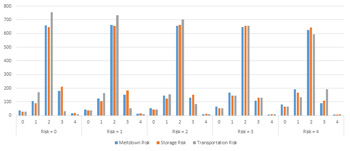
Note: Simulation out of 1000 stakeholders. Risk values increase from 0 = not at all concerned, to 4 = very concerned.