Advances in Engineering Advances in Engineering features breaking research judged by Advances in Engineering advisory team to be of key importance in the Engineering field. Papers are selected from over 10,000 published each week from most peer reviewed journals.

Evgueni Todorov
NDT & E International, Volume 48, June 2012
Abstract
Electromagnetic properties of heat exchanger tubes with outside diameter in the range from 15.8 mm to 25.3 mm and wall thickness in the range from 0.63 mm to 1.6 mm made of SAF 2205, Type 439 and Sea-Cure were determined with model-based eddy current technique. Two encircling eddy current measurement sensors with uniform field were optimized and designed based on initial computer modeling results. A precision measurement circuit was assembled with the sensors and a lockin amplifier. Sensor computer models were built and validated through direct magnetic and voltage measurements. The sensor magnetic field uniformity was tested and agreed very well with model predictions. The sensor resonance frequencies were verified to ensure resonance effects would not interfere with the measurement process. The tubes’ electrical conductivity and initial magnetic permeability were determined through optimization process minimizing the “cost” (objective) function at three frequencies 200 Hz, 1 kHz, and 2.5 kHz. The agreement between the eddy current and other conventional destructive magnetic and electrical measurements was very good where relevant comparison was possible.
Additional Information
Nondestructive evaluation (NDE) systems are qualified for critical applications such as nuclear power plants, jet engines and others through extensive practical trials with specimens with multiple flaws and conditions. The practical trials are expensive and time consuming. Computer modeling and simulation is recently considered for quantification of NDE system performance expressed in probability of flaw detection (POD) and accuracy of sizing. Tubes in nuclear power plant heat exchangers are inspected with various electromagnetic techniques inservice. While physical and chemical properties of new ferromagnetic tube materials are well studied, little is known regarding the electrical conductivity and magnetic properties needed for reliable performance simulation of electromagnetic NDE techniques.
Nuclear Fabrication Consortium (NFC) at EWI sponsored a major study for evaluation of electrical conductivity and magnetic properties of heat exchanger tubes made of new materials. Electric Power Research Institute (EPRI) cosponsored the study and would use the results further for optimization of existing and new NDE electromagnetic techniques. A precision laboratory data-acquisition test system was integrated and tested for electromagnetic property measurement. Extensive optimization of sensor performance through modeling was conducted (Figure 1). Direct magnetic and electrical measurements were performed to validate the system and determine the usable frequency range.
An iterative algorithm was proposed and demonstrated to determine the electrical conductivity and initial magnetic permeability of tubes (Figure 2). The process involved building and running a computer model of sensor-tube interaction where the tube material properties were varied in such a way that the difference between the modeled and measured sensor induced voltage was minimized.
The tube electrical conductivity and initial relative magnetic permeability were simultaneously measured at several frequencies. The results compared very well with conventional direct (DC) and alternate (AC) current magnetic measurements. Four-terminal DC and AC electrical conductivity measurements with custom built fixture also compared well and validated the eddy current model-based results.
A model-based eddy current (EC) technique for electromagnetic property (electrical conductivity and initial magnetic permeability) measurement was created and validated.
The electromagnetic properties are now available for the first time (according to our knowledge) for researchers and practitioners developing and optimizing electromagnetic NDE techniques.
Measurable differences requiring further investigation were found between the magnetic properties of the two Sea-Cure tubes with different nominal tube wall thicknesses.
Similar approach could be used for NDE measurement of chemical and phase composition, stress, corrosion and other important material characteristics where reliable correlation with the electromagnetic properties exists.
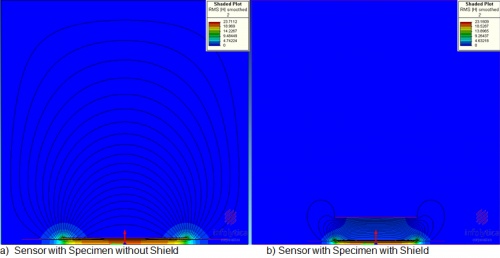
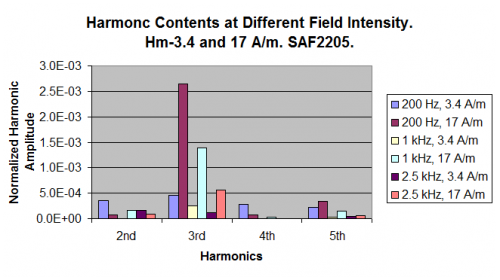
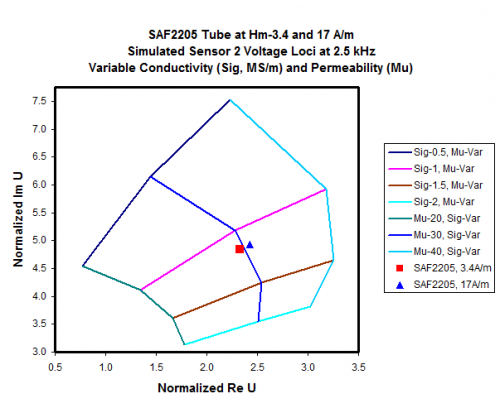
Figure 2
Go to Journal