Advances in Engineering Advances in Engineering features breaking research judged by Advances in Engineering advisory team to be of key importance in the Engineering field. Papers are selected from over 10,000 published each week from most peer reviewed journals.

Experiments in Fluids, 2015, 56:38.
Hanns Müller-Vahl 1,2, Christian Navid Nayeri 2, Christian Oliver Paschereit 2, David Greenblatt1
- Faculty of Mechanical Engineering, Technion – Israel Institute of Technology, 32000, Technion City, Haifa, Israel.
- Institute of Fluid Dynamics and Technical Acoustics, Berlin Institute of Technology, 10623, Berlin, Germany.
Abstract
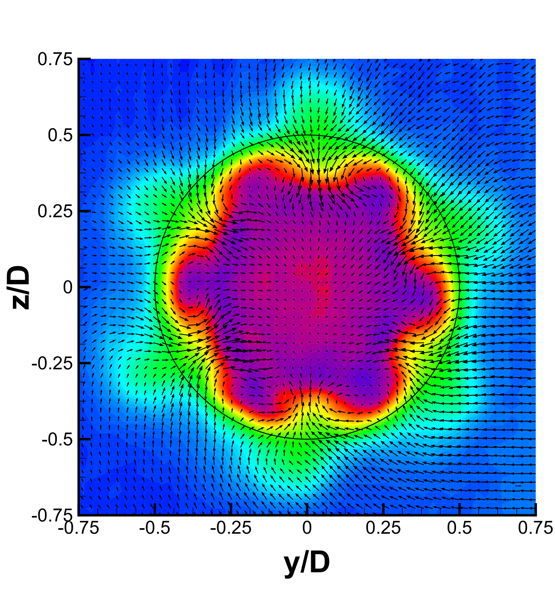
A novel active control concept aimed at mixing enhancement of an axisymmetric incompressible jet was investigated experimentally. The lip of the jet was equipped with evenly distributed small flaps, or flaplets, deflected away from the stream at an angle of 30°. Controlled attachment of the jet’s boundary layer to the flaps was achieved by introducing zero mass-flux perturbations through control slots located at the base of the flaps, yielding a radial deflection of the shear layer. As a result, pairs of strong streamwise vortices of a finite length were periodically generated and shed in phase with the control signal. At a Strouhal number of 0.3 based on the nozzle diameter, the perturbations also regulated the shedding of spanwise vortex rings. Hot-wire measurements in the vicinity of the flaplets as well as phase-averaged stereoscopic PIV measurements at various streamwise locations were employed to elucidate the mechanism of controlled attachment and to map the evolution of the coherent structures. The strength of axial vorticity was strongly dependent upon the control frequency. A semiempirical framework adopted to quantify the overall effect of control predicted a significant increase in mixing in the region close to the nozzle.