Advances in Engineering Advances in Engineering features breaking research judged by Advances in Engineering advisory team to be of key importance in the Engineering field. Papers are selected from over 10,000 published each week from most peer reviewed journals.

SIGNIFICANCE STATEMENT
Most mirror-scanning mechanisms are electromagnetically actuated because the electromagnetic design usually offers large angular range. But such electromagnetic mechanisms suffer from disadvantages such as low resonance frequencies and high power consumption. In comparison, the piezoelectric design is superior with regard to large force, high positioning resolution, cost effectiveness, and an absence of electromagnetic interference issues. However, due to the small deformation range of the piezoelectric materials, which is only about 10 μm cm−1, existing piezoelectric scanners typically have limited angular travel.
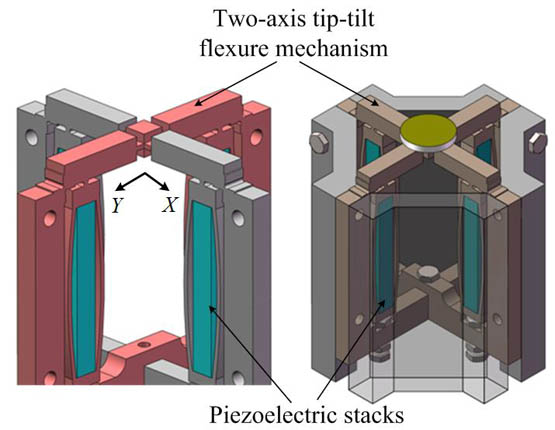
A unique structure of tip-tilt flexure mechanism employing piezoelectric stack is presented in this work to address this problem and a mathematical model of this mechanism is established to guide the design of such a type of devices. The results indicate that this scanner is very promising for practical applications and the mathematical model have the sufficient accuracy to be extended in conjunction with optical parameters of the scanning devices.
Journal Reference
Zijian Jing, Minglong Xu , Bo Feng. Smart Materials and Structures Volume 24 Number 2, 2015.
State Key Laboratory for Strength and Vibration of Mechanical Structures, School of Aerospace, Xi’an Jiaotong University, Xi’an 710049, People’s Republic of China .
Abstract
Mirror-scanning mechanisms are a key component in optical systems for diverse applications. However, the applications of existing piezoelectric scanners are limited due to their small angular travels. To overcome this problem, a novel two-axis mirror-scanning mechanism, which consists of a two-axis tip-tilt flexure mechanism and a set of piezoelectric actuators, is proposed in this paper. The focus of this research is on the design, theoretical modeling, and optimization of the piezoelectric-driven mechanism, with the goal of achieving large angular travels in a compact size. The design of the two-axis tip-tilt flexure mechanism is based on two nonuniform beams, which translate the limited linear output displacements of the piezoelectric actuators into large output angles. To exactly predict the angular travels, we built a voltage-angle model that characterizes the relationship between the input voltages to the piezoelectric actuators and the output angles of the piezoelectric-driven mechanism. Using this analytical model, the optimization is performed to improve the angular travels. A prototype of the mirror-scanning mechanism is fabricated based on the optimization results, and experiments are implemented to test the two-axis output angles. The experimental result shows that the angular travels of the scanner achieve more than 50 mrad, and the error between the analytical model and the experiment is about 11%. This error is much smaller than the error for the model built using the previous method because the influence of the stiffness of the mechanical structure on the deformation of the piezoelectric stack is considered in the voltage-angle model.
Go To Smart Materials and Structures
FEATURED AUTHORS INFORMATION

Zijian Jing, is currently a Ph.D. candidate at State Key Laboratory for Strength and Vibration of Mechanical Structures, School of Aerospace, Xi’an Jiaotong University, China. He received his MS degree from Xi’an Jiaotong University, China, in 2013. His research interests include development of piezoelectric actuators incorporated with mechanical transformer and application of the piezoelectric mechanisms for optical communication equipment.

Minglong Xu, received his B.S., M.S. and Ph.D. degrees in mechanics from Xi’an Jiaotong University, China, in 1984, 1987 and 1998 respectively. He was a research fellow at Tokyo Denki University, Tokyo, Japan, in 1995. Currently, he is a professor at School of Aerospace, Xi’an Jiaotong University and deputy director of State Key Laboratory for Strength and Vibration of Mechanical Structures, China. His present research interest includes piezoelectric transducer and actuator, active vibration control, energy harvesting from oscillation and other novel utilization of vibration. He is the author and co-author of more than 80 papers and 50 disclosed patents.