Advances in Engineering Advances in Engineering features breaking research judged by Advances in Engineering advisory team to be of key importance in the Engineering field. Papers are selected from over 10,000 published each week from most peer reviewed journals.

Small, Volume 9, Issue 23, page 4088, December 9, 2013.
Dai Zhang2, Alfred J. Meixner2, Frank Schreiber1,Dieter P. Kern1 , Monika Fleischer1,*
1. Institute for Applied Physics and Center LISA[+], Eberhard Karls Universität Tübingen, Auf der Morgenstelle 10, 72076 Tübingen, Germany.
2. Institute of Physical and Theoretical Chemistry and Center LISA[+], Eberhard Karls Universität Tübingen, Auf der Morgenstelle 15, 72076 Tübingen, Germany.
Abstract
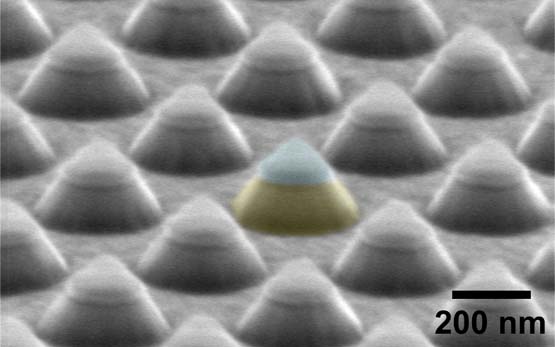
Ordered arrays of nanocones and nanopyramids are fabricated in a fully parallel approach by M. Fleischer and co-workers, as reported on page 3987. Single or double layers of self-assembled nanospheres are directly modified or used as templates for the creation of etch masks. Nanocones with sharp tips form when the masks are transferred into a gold or silver layer. Under optical excitation, narrowly confi ned hotspots are created near the cone tips. These structures have interesting properties for nano-optical applications and are evaluated as substrates for surface enhanced Raman spectroscopy using a thin film of pentacene molecules.
Copyright © 2013 WILEY-VCH Verlag GmbH & Co. KGaA, Weinheim.
Figure Legend
“Fabrication of an array of gold nanocones for surface enhanced Raman scattering. Intermediate scanning electron microscope image of truncated gold nanocones with caps after ion milling a gold film with polystyrene spheres on top for some time.”