Advances in Engineering Advances in Engineering features breaking research judged by Advances in Engineering advisory team to be of key importance in the Engineering field. Papers are selected from over 10,000 published each week from most peer reviewed journals.

Journal of Nondestructive Evaluation, 2014, Volume 33, Issue 1, pp 62-73. Andrés David Restrepo Girón, Humberto Loaiza Correa.
1. Facultad de Ingeniería, Universidad Santiago de Cali, Calle 5 Carrera 62, Sede Pampalinda, Cali, Colombia.
2. Escuela de Ingeniería Eléctrica y Electrónica, Universidad del Valle, Calle 13 Carrera 100, Sede Meléndez, Cali, Colombia.
Abstract
The Finite Difference Thermal Contrast (FDTC) is a new technique based on the approximation to the discretization of the Fourier heat propagation model in 3D, in order to be applied on a sequence of infrared images to enhance contrast for automatic detection and characterization of flaws in composite slabs. This contrast enhancement is performed by the calculus of relative error between predicted and real temperature over the heated surface only and for each pixel, in such a way that defective regions will exhibit greater errors than sound ones. Thermal sequences from a simulated Carbon Fiber Reinforced Plastic (CFRP) slab with air-filled defects, and from a real CFRP slab sample with Teflon squared defects, are used to evaluate and compare the enhancement obtained from FDTC, Normalized Contrast (NC) and Modified Differential Absolute Contrast (m-DAC). In spite of the need of executing an additional background compensation in case of real slabs, results show that the proposed technique offers a better contrast between defects and background than the other techniques (about 33 % less residuary thermal non-uniformity with the adjusted version—FDTCa), mainly because of the more energy of the resulting thermal profiles. Also, as this technique does not estimate the temperature distribution along depth axis, but approximates temperature after a spatial step only, it can run faster than other thermal reconstruction methods like the classic 3D thermal filtering.
Significance statement.
The FDTC method is based on the discretization of the Fourier heat propion model in 3D, and the approximation of thermal distribution in depth direction (z axis) by applying the 1D solution to the corresponding differential equation proposed by Tadeus and Simoes, for just an infinitesimal displacement and a slab configuration with null heat fluxes on both sides of the layer.
Since the developed algorithm does not need to perform temperature estimation in all of the spatial axes throughout the material in every sample time, it is able to achieve a substantial reduction in execution time compared to techniques using 3D models for simulation and inversion tasks, and a more reliable contrast enhancement performance because every estimation is updated at each time (e.g. for each thermogram) from real temperatures, and not from ideal initial conditions and theoretical temperature data like in typical 3D thermal filtering method. Moreover, FDTC can be implemented as a dynamic mask filter without requiring a previous selection of a healthy area of material or any reference thermogram.
In real thermographic experiments, it is better to work with accumulated profiles to reduce noise influence; nevertheless, it is probably as well that sound accumulated profiles deviate notoriously from an ideal flat behavior. For that reason, an additionally median filtering procedure* has been proposed by the authors**, leading to an adjusted FDTC method (FDTCa) that offers the best results in real cases.
* RESTREPO, Andrés; LOAIZA, Humberto. Non-uniform Heating Compensation on Thermal Images using Median Filtering. DYNA, journal of the Faculty of Mines at Universidad Nacional de Colombia, Medellín, volume 80, issue 182, December 2013, pp. 74-82. Available at:
http://dyna.unalmed.edu.co/en/ediciones/182/articulos/v80n182a09/v80n182a09.pdf
**The actual affiliation of both authors is:
School of Electrical and Electronic Engineering, Faculty of Engineering, Universidad del Valle, Cali, Colombia.
Andrés David Restrepo-Girón: [email protected]
Humberto Loaiza-Correa: [email protected]
Figure legend.
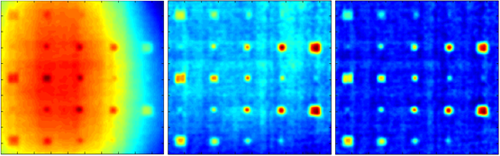
Comparative example of real thermograms from: original thermal sequence, at the left; from FDTC technique, at the middle; and from adjusted FDTC (FDTCa) at the right. The sequence was taken from an inspection procedure of carbon fiber reinforced plastic (CFRP) slabs of 2 mm with 25 Teflon squared defects. (Acknowledgement to MIVIM research group at University Laval)