 Advances in Engineering Advances in Engineering features breaking research judged by Advances in Engineering advisory team to be of key importance in the Engineering field. Papers are selected from over 10,000 published each week from most peer reviewed journals.

Significance Statement
The measurement of the thickness of a layer in multilayered sample in the nanometer range is performed using angle resolved XPS (AR-XPS). In the field of tribology, such measurements are used for determining the depth of the absorbed lubricant in wear tests or to measure the distribution and orientation of adsorbed molecules. When the amplitude of the texture of the engineered/tribological surfaces is in the order of a micrometer, effects of electron shadowing significantly influence the interpretation of acquired spectra, i.e., the surface facets screen the emitted photo-electrons. This can bias the calculation of the thicknesses of the layers of up to 50%. Commercial software commonly uses the Beer-Lambert law for electrons absorption to fit AR-XPS spectra and determine the layer structure. These software packages are not able to consider topographical effects in the calculation of the depth distribution of the elements of interest, nor are able to consider the real topography of the characterized surface.
We have developed a numerical scheme, called extended Beer-Lambert law (eBLL), capable of considering the spatially resolved orientation of the topography (measured) and subsequent shadowing of photoelectrons in AR-XPS spectra using a facet approximation to model the structure of samples.
A method to evaluate quantitatively the layered structure of corrugated rough and structured samples is also provided by combination of calculation with experimental data, both topographical and spectroscopic, with the proposed numerical scheme.
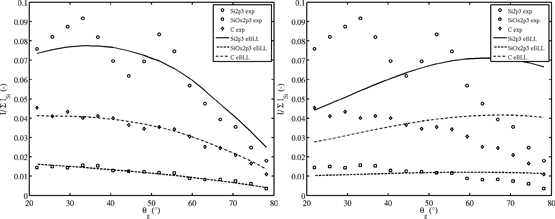
Testing the proposed eBBL against experimental data as well as data obtained with a widely used software package, SESSA, showed that the agreement is fairly good. We have tested the scheme by combining ex-situ AFM topographic measurements of a silicon structured sample with a native oxide layer. By the introduction of geometrical correction introduced via the eBLL, we showed that it is possible to correct most of the fitting problem due to shadowing and to resolve correctly the layers.
Figure legend: AR-XPS spectra fitting, with shadowing algorithm (left) and without (right)
Journal Reference
Bianchi1,,L. Katona1,J. Brenner1, G. Vorlaufer1, A. Vernes1,2 , W. S. M. Werner2. Surface and Interface Analysis, Volume 47, Issue 1, pages 15–21, (2015).
[expand title=”Show Affiliations”]- AC2T research GmbH, Austrian Center of Competence for Tribology, Viktor-Kaplan-Strasse 2C, 2700 Wiener Neustadt, Austria.
- Institute of Applied Physics, Vienna University of Technology, Wiedner Hauptstraße 8–10 /134, 1040 Vienna, Austria.
Abstract
A computational scheme is presented that takes into account the topography, i.e. the shadowing and hence the local emission angle of the electrons when evaluating AR-XPS data of macroscopic rough surfaces. The topography of the sample surface is supposed to be recorded by atomic force microscopy and/or optical microscopy. The emitted photoelectrons are simulated based on an extension of the Beer–Lambert law that includes the shadowing, the current local emission angle, and the geometrical instrument setup. The obtained angle-resolved XPS spectra are optimized in accordance with experimental ones via a self-consistent minimization algorithm that also allows one to determine the layer thicknesses of the corrugated sample. In order to validate the proposed numerical scheme, the simulation program simulation of electron spectra for surface analysis is used. An additional analysis is then performed considering only experimental data. The numerical scheme gives good agreement in simulation–simulation as well as simulation–experiment comparisons and permits a comprehensible interpretation of the measured data.
Copyright © 2014 John Wiley & Sons, Ltd.