Advances in Engineering Advances in Engineering features breaking research judged by Advances in Engineering advisory team to be of key importance in the Engineering field. Papers are selected from over 10,000 published each week from most peer reviewed journals.

Applied Thermal Engineering, Volume 70, Issue 1, 5 September 2014, Pages 510-523.
Eva Kroenera, Andrea Vallatib, Marco Bittellic
a-Soil Hydrology, Georg August University of Göttingen, Büsgenweg 2, 37077 Göttingen, Germany and
b-Department of Astronautics, Electrical and Energy Engineering, Sapienza University of Rome, Via Eudossiana 18, 00184 Rome, Italy and
c-Department of Agricultural Science, University of Bologna, Viale Fanin 44, 40125 Bologna, Italy.
Abstract
The trend towards renewable energy comes along with a more and more decentralized production of electric energy. As a consequence many countries will have to build hundreds or even thousands of miles of underground transmission lines during the next years. The lifetime of a transmission line system strongly depends on its temperature. Therefore an accurate calculation of the cable temperature is essential for estimating and optimizing the system’s lifetime.
The International Electrotechnical Commission and the Institute of Electronics and Electrical Engineers are still employing classic approaches, dating back from the 1950s, that are missing fundamental phenomena involved in heat transport in soils. In recent years several authors [4,37] pointed out that for a proper computation of heat transport in soils, physical processes describing heat, liquid water and vapor transport must be coupled and the respective environmental weather conditions need to be considered.
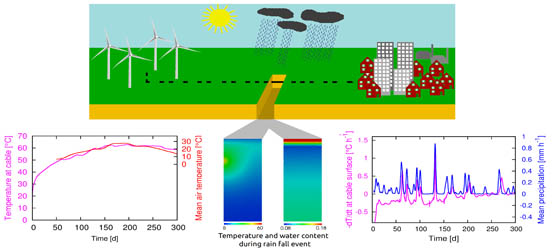
In this study we present a numerical model of coupled liquid water, vapor and heat flow, to describe heat dissipation from underground cables. At first the model is tested and validated on a downscaled experiment [32], secondly the model is applied on a simplified system to demonstrate the strong relation of the cable temperature on soil water content and finally the model is applied using real weather conditions to demonstrate that small changes in the design of underground transmission line systems can lead to considerable improvements in both average as well as peak-to-peak temperatures.