 Advances in Engineering Advances in Engineering features breaking research judged by Advances in Engineering advisory team to be of key importance in the Engineering field. Papers are selected from over 10,000 published each week from most peer reviewed journals.

Significance statement
Computing equivalent resistance of various electrical circuits has always been of interest to physicists, mathematicians and engineers. A vast amount of literature exists on circuits of special type, but relatively few attempts have been made to derive a closed formula for equivalent resistance of a generic circuit (see e.g. Ref.[1]). Ref. [2] presents such a closed formula for an absolutely arbitrary electric circuit in a particularly simple way. This opens up an avenue for applications in multiple adjacent fields. We summarize the essence of the approach in Ref. [2] below.
For a circuit with n nodes, designate the edge conductance (inverse resistance) between nodes i and j as σij =1/Rij =σji ≥ 0 and fill out the following n×n matrix Σ1 in Fig. 1. If a pair of nodes is not connected directly, the corresponding σ should simply be put to zero.

Figure Legend
Construction of Σ-matrix. Sub-matrices Σ′ and Σ′′ are used to compute the equivalent conductance/resistance of the circuit. Reproduced with permission from the online appendix of Ref. [3], Phys. Teach. 53, 196 (2015); http://dx.doi.org/10.1119/1.4914552. Copyright 2015, American Association of Physics Teachers.
Here, the diagonal entries are the “total” conductance at the corresponding node 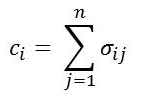 . Assuming that the battery is connected to the first and last nodes, we will need two sub-matrices Σ′ and Σ′′ (see Fig. 1), in terms of which the equivalent conductance of the circuit is given by
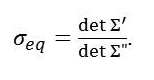
Eq. (1) constitutes a closed formula for the equivalent conductance/resistance across nodes 1 and n of an arbitrary circuit. In order to compute Req across a different pair of nodes, one needs to consider a different Σ′′ by crossing out the corresponding two rows and columns from the original Σ-matrix. Remarkably, the determinant of Σ′ does not depend on which one row and one column are crossed out.
Interestingly, Eq. (1) unveils a curious interplay between electrical circuits, matrix algebra, graph theory and its applications to computer science. Specifically, there is a straightforward correspondence between electrical circuits and random walks on graphs, [4] including the concept of escape probability, which is a direct analog of equivalent resistance. These connections are particularly useful, as there is much physical intuition about electrical circuits that could give rise to some less obvious mathematical statements.
[1] This matrix is usually referred to as the weighted (generalized) Laplacian matrix.References
[1] D. J. Klein and M. Randić, Resistance distance, J. Math. Chem., Vol 12, 81-95 (1993).F. Y. Wu, Theory of resistor networks: the two-point resistance, J. Phys. A: Math. Gen. 37, 6653-6673 (2004).
[2] M. Kagan, “On equivalent resistance of electrical circuits,’’ Am. J. Phys. 83, 53 (2015). [3] M. Kagan, J. He, H. Jin “Comments on “Platonic Relationships Among Resistors’’ Phys. Teach. 53, 196 (2015). [4] Peter Doyle and Laurie Snell, Random Walks and Electric Networks, (Mathematical Assn of America, USA, 1984)
Journal Reference
Am. J. Phys. 83, 53 (2015). Mikhail Kagan.
Division of Science and Engineering, The Pennsylvania State University, Abington College, Abington, Pennsylvania 19116.
Abstract
While the standard (introductory physics) way of computing the equivalent resistance of nontrivial electrical circuits is based on Kirchhoff’s rules, there is a mathematically and conceptually simpler approach, called the method of nodal potentials, whose basic variables are the values of the electric potential at the circuit’s nodes. In this paper, we review the method of nodal potentials and illustrate it using the Wheatstone bridge as an example. We then derive a closed-form expression for the equivalent resistance of a generic circuit, which we apply to a few sample circuits. The result unveils a curious interplay between electrical circuits, matrix algebra, and graph theory and its applications to computer science. The paper is written at a level accessible by undergraduate students who are familiar with matrix arithmetic. Additional proofs and technical details are provided in appendices.
© 2015 American Association of Physics Teachers.
Go To Am. J. Phys.