Advances in Engineering Advances in Engineering features breaking research judged by Advances in Engineering advisory team to be of key importance in the Engineering field. Papers are selected from over 10,000 published each week from most peer reviewed journals.

Small. 2014 Mar 26;10(6):1184-93.
Huynh E, Lovell JF, Fobel R, Zheng G.
Ontario Cancer Institute and Techna Institute, University Health Network, Toronto, Ontario M5G1L7, Canada, Department of Medical Biophysics, University of Toronto, Ontario, M5G1L7, Canada.
Abstract
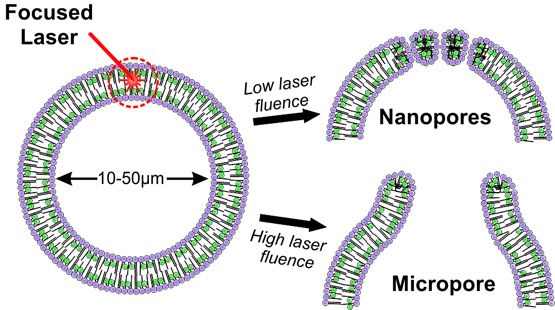
Efforts to develop self-contained microreactors and artificial cells have been limited by difficulty in generating membranes that can be robustly and repeatedly manipulated to load and release cargo from phospholipid compartments. Here we describe a purely optical method to form pores in amembrane generated from porphyrin-phospholipid conjugates electro-assembled into microscale giant porphyrin vesicles and manipulated using confocal microscopy. The pores in the membrane resealed within a minute allowing for repeated pore formation with precise spatial and temporal control and optical gating to allow selective diffusion of biomolecules across the membrane. Temporal control of pore formation was illustrated by performing sequential DNA hybridization reactions. A biotin-avidin based strategy was developed to selectively attach enzymes to the interior of the vesicle, demonstrating spatial control and the potential of giant porphyrin vesicles as versatile microreactors.
© 2013 WILEY-VCH Verlag GmbH & Co. KGaA, Weinheim.