Advances in Engineering Advances in Engineering features breaking research judged by Advances in Engineering advisory team to be of key importance in the Engineering field. Papers are selected from over 10,000 published each week from most peer reviewed journals.

Chitra Arora, Prasad K. Bhaskaran
Ocean Engineering, Volume 43, April 2012
Abstract
A comprehensive knowledge of the wave climate is an essential pre-requisite for practical applications in coastal and near-shore region. In coastal areas the dominant dissipative mechanism appears to be bottom friction where the relative strength depends on bottom characteristics, sediment type and bottom ripple geometry. The present state-of-art version SWAN wave model uses three popular formulations for dissipative mechanism due to bottom interaction. The bottom friction coefficient as in SWAN cannot be a constant and needs to be tuned based on prevailing hydrodynamic conditions when applied for a tidal dominant region. A combined wave-current interaction study should take into account varying water levels, reversal of current system and associated shear on the sea-bed. The present work reports on development of a new resistance law for bottom friction under the combined action of waves and currents. This new formulation has been implemented in the SWAN model and further its implication on variability of significant wave height for the Hooghly estuary located in the Bay of Bengal, East coast of India was investigated by comparison with ENVISAT satellite measurement. Based on this study, it could be ascertained that new friction formulation has potential for wind-wave modeling studies in near-shore and coastal waters.
Highlights
The dominant dissipative mechanism pertaining to wave propagation in near-shore waters is the bottom friction. Relative strength of bottom dissipation has a strong dependency on bottom characteristics, sediment type and bottom ripple geometry. The present state-of-art SWAN wave model utilizes three popular frictional formulations for sandy bottoms assumed intrinsically constant in space and time for surface waves propagation in coastal environment. The bottom friction cannot be a constant as specified in SWAN model, which needs to be essentially tuned based on prevailing hydrodynamic conditions when applied in a tidal dominated environment. Hence, there is a need to develop advanced algorithms which takes into account the effects of combined wave-current interaction as an integrated system by considering varying water levels, reversal of current system and their associated shear on the sea-bed.
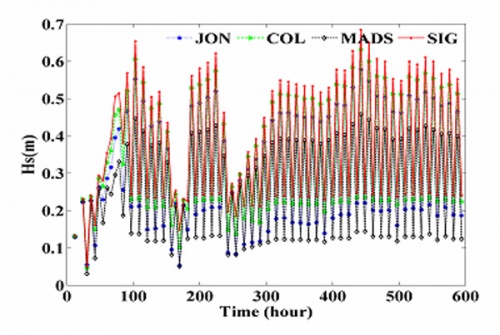
A new resistance law was developed for bottom friction under the combined action of waves and currents for the tidal dominated Hooghly estuary located in the east coast of India. The Hooghly estuary is a part of the Sunderban deltaic system dominated by tides. Two major national ports viz; Kolkata and Haldia are located in this estuary, where the tidal effects extends approximately 175 miles upstream. The Hooghly estuary is highly dynamic in terms of its suspended load having annual runoff approximately 493 Km3 carrying about 616 x 106 tonnes of suspended solids to estuary mouth. In context to suspended sediment load discharge in Bengal deltaic fan, it is considered the second major river in the world. The developed algorithm has been implemented in state-of-art SWAN wave model and variability of significant wave heights in the Hooghly estuary was investigated. The key features notable in the nonlinear wave-current interaction study was the simultaneous nonlinear effects arising due to oscillatory and turbulent flow. The changes in bottom frictional characteristics due to combined wave-current interaction was treated in an appropriate manner for the complex bottom topography in the Hooghly basin. The postulated dynamically varying bottom friction coefficient from this study is not an external parameter, but one of the internal parameters embedded in the modified model. This is controlled by external conditions relevant to hydrodynamic properties of the sea bottom, wind stress, fetch and water depth. The comparison of significant wave height data from ENVISAT demonstrates that the new formulation yields satisfactory results. It is therefore advocated that this new resistance law can have profound applications on hydrodynamic and wind-wave modeling studies.
Go to Journal