Advances in Engineering Advances in Engineering features breaking research judged by Advances in Engineering advisory team to be of key importance in the Engineering field. Papers are selected from over 10,000 published each week from most peer reviewed journals.

Takatoshi Matsumoto and Kiyoko Takamura.
Analytical Methods, Issue 12, 2012 .
Abstract
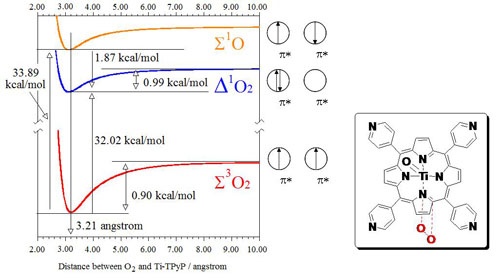
The Ti-TPyP reagent, i.e. an acidic aqueous solution of oxo[5,10,15,20-tetra(4-pyridyl)-porphyrinato]titanium(IV) complex, denoted as TiO(tpyp), was developed as a highly sensitive and specific reagent for detecting hydrogen peroxide. In our previous paper, the photosensitizing effect of the TiO(tpyp) complex on the detection of hydrogen peroxide using this reagent was explored based on the experimental findings. In the present paper, computational analysis was carried out for the molecular level elucidation of the energy transfer mechanism between the photo-excited TiO(tpyp) complex and triplet oxygen to form singlet oxygen under aqueous acidic conditions. The protonated form of the TiO(tpyp) complex, i.e. [TiO(tpypH4)]4+complex, was found to be the entity responsible for the energy transfer to triplet oxygen. The interaction sites between the [TiO(tpypH4)]4+ complex with triplet oxygen were then discussed based on their molecular orbital characteristics and the potential energy changes accompanying the approach of triplet oxygen molecule Σ3O2 to the [TiO(tpypH4)]4+ complex. The obtained results show that the C–N portion of the porphyrin ring plays a predominant role in the energy transfer from the photo-excited porphyrin to Σ3O2. Σ3O2 is then converted to {DELTA}1O2 through Σ1O2. The {DELTA}1O2 molecule reaches its stable state at the distance of 3.21 Å from the C–N portion of the porphyrin ring with its stabilization energy of 0.99 kcal mol−1. The stabilization energy for the {DELTA}1O2 molecule thus formed is small, implying no stable bond formation between the {DELTA}1O2molecule and the [TiO(tpypH4)]4+ complex and that it moves away from the C–N portion immediately after the energy transfer from the photo-excited porphyrin
Additional Information:
Hydrogen peroxide is one of the most significant target analytes in many fields such as environmental, biomedical and agricultural area. We have so far developed some reagents to detect trace levels of hydrogen peroxide. The reagents should be highly sensitive and specific to hydrogen peroxide. Among them, oxo[5,10,15,20-tetra(4-pyridyl)porphyrinato]titanium(IV) complex, denoted as TiO(tpyp), was found to be the most promising one, because titanium(IV) has strong chemical affinity to hydrogen peroxide and porphyrin ligand has intense light-absorbing property at around 400–450 nm. The Ti-TPyP reagent thus developed, i.e. an acidic aqueous solution of the TiO(tpyp) complex, proved to be a highly sensitive and specific reagent for detecting hydrogen peroxide. The specificity of the Ti-TPyP reagent to hydrogen peroxide was successfully clarified based on ab initio calculations. The results contributed to confirming the accuracy of the analysis using the Ti-TPyP reagent.
Meanwhile, interference from ascorbic acid concurrently present in the real samples became apparent. The presence of ascorbic acid over 10% of hydrogen peroxide led to a considerable positive error in the analytical results. This was a serious problem in the practical uses of the Ti-TPyP reagent. Occurrence of the positive error was previously revealed to be due to the production of hydrogen peroxide through the oxidation of ascorbic acid by singlet oxygen arising from the energy transfer between dissolved oxygen molecule and the photo-excited TiO(tpyp) complex.
A number of studies have been reported on the photo-excitation effects of porphyrins on triplet oxygen to convert it to singlet oxygen. However, it has not yet been clear which site of the porphyrin molecule plays a predominant part in the conversion of an oxygen molecule from its triplet to singlet state, although it is important for the molecular level elucidation of how triplet oxygen interacts with porphyrin molecule. To clarify this problem, the present paper dealt with the interaction mechanism between the TiO(tpyp) complex and triplet oxygen molecule from the viewpoint of their molecular orbital characteristics and the potential energy changes based on the computed results.