Advances in Engineering Advances in Engineering features breaking research judged by Advances in Engineering advisory team to be of key importance in the Engineering field. Papers are selected from over 10,000 published each week from most peer reviewed journals.

Ryan S. McGinnis, Noel C. Perkins, Kevin King
Procedia Engineering, Volume 34, 2012
Abstract
Proper pitching mechanics are imperative for developing different types of pitches (e.g., fastball vs. breaking ball) and for preventing injury. Different pitch types are distinguished by the path (i.e. break) and speed of the ball which, in turn, are dictated by the angular velocity of the ball and the velocity of the ball center at the instant of release from the pitcher’s hand. While radar guns effectively measure ball speed, they provide no information about the direction of the velocity of the ball center, the angular velocity of the ball, or the way in which these quantities change during the throw. These quantities can, in principle, be calculated using high-speed video-based motion capture (mocap), but doing so requires measurements in a controlled lab environment taken by a skilled technician. Moreover, mocap is unlikely to accurately resolve the angular velocity of the ball which is crucial to understanding pitching. This paper addresses these shortcomings by presenting an instrumented ball containing a miniature, wireless inertial measurement unit (IMU) to measure ball dynamics on the field of play. Measurements reveal that this technology can deduce the magnitude and direction of the ball’s velocity at release to within 4% when benchmarked against mocap. Moreover, the IMU directly measures the angular velocity of the ball for pitches that remain within the measurement range of the associated angular rate gyros.
Additional Information
Figure 1 illustrates the IMU hardware employed in this study. This design, believed to be the world’s smallest wireless IMU, was developed at the University of Michigan following a lineage of previous designs.
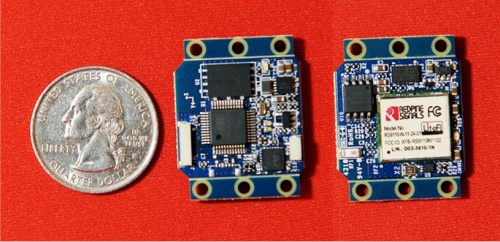
Figure 1: Miniaturized IMU developed at the University of Michigan. Image shows size of IMU relative to a quarter and both faces of the design. The IMU provides wireless 3-axis measurement of acceleration and angular velocity.
To date, our IMU technology has been used in both research and commercialization activities for the sports of golf (King, et al., Sensors and Actuators A: Physical, 2008), baseball/softball batting and pitching (King, et al., Sports Engineering, 2012; McGinnis and Perkins, Sensors, 2012), bowling (King, et al., Sports Engineering, 2011), among other applications. In addition, the technology has been used in rigid-body dynamics studies (McGinnis, et al., ASME Journal of Applied Mechanics, 2012) and for human motion analysis with applications to biomechanics and health monitoring. Opportunities exist for research and licensing partnerships.
Go to Journal