Advances in Engineering Advances in Engineering features breaking research judged by Advances in Engineering advisory team to be of key importance in the Engineering field. Papers are selected from over 10,000 published each week from most peer reviewed journals.

Progress in Polymer Science,Volume 37, Issue 9, September 2012, Pages 1192–1264
Ling-Hai Xie, Cheng-Rong Yin, Wen-Yong Lai, Qu-Li Fan, Wei Huang.
Key Laboratory for Organic Electronics & Information Displays (KLOEID) and Institute of Advanced Materials (IAM), Nanjing University of Posts & Telecommunications (NUPT), Nanjing 210046, China
Abstract
Polyfluorenes have emerged as versatile semiconducting materials with applications in various polymer optoelectronic devices, such as light-emitting devices, lasers, solar cells, memories, field-effect transistors and sensors. Organic syntheses and polymerizations allow for the powerful introduction of various periodic table elements and their building blocks into π-conjugated polymers to meet the requirements of organic devices. In this review, a soccer-team-like framework with 11 nodes is initially proposed to illustrate the structure–property relationships at three levels: chain structures, thin films and devices. Second, the modelling of hydrocarbon polyfluorenes (CPFs) is summarized within the framework of a four-element design principle, in which we have highlighted polymorphic poly(9,9-dialkylfluorene)s with unique supramolecular interactions, various hydrocarbon-based monomers with different electronic structures, functional bulky groups with steric hindrance effects and ladder-type, kinked, hyperbranched and dendritic conformations. Finally, the detailed electronic structure designs of main-chain-type heteroatomic copolyfluorenes (HPFs) and metallopolyfluorenes (MPFs) are described in the third and fourth sections. Supramolecular, nano and soft semiconductors are the future of polyfluorenes in the fields of optoelectronics, spintronics and electromechanics.
Additional Information
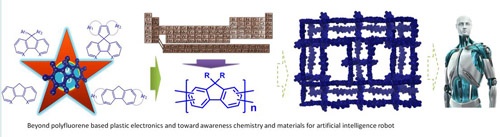
The principle of four-element rational design will also offer the basic template for other conjugated polymers to achieve stable high-performance polymer solar cells, polymer light-emitting devices, polymer memory, thin film transistors, sensors and actuators. Beyond macromolecular polyfluorenes, fluorene-based soluble organic nanoscale frameworks and networks that open a door to frame chemistry and materials will revolute state-of-the-art advanced smart and awareness materials for artificial intelligence robot.