Advances in Engineering Advances in Engineering features breaking research judged by Advances in Engineering advisory team to be of key importance in the Engineering field. Papers are selected from over 10,000 published each week from most peer reviewed journals.

Energy and Buildings, Volume 69, February 2014, Pages 473-480
M.P. Moralesa, M.C. Juárezb, , P. Muñozc, M.A. Mendívilb, J.A. Ruizd
a -Facultad de Ingeniería, Universidad Autónoma de Chile, Av. Pedro de Valdivia 641 Providencia, Santiago, Chile and
b-Escuela Técnica Superior de Ingeniería Industrial, Universidad de La Rioja, Luis de Ulloa 20, 26004 Logroño, La Rioja, Spain and
c-Facultad de Ingeniería Civil, Universidad Autónoma de Chile, 5 Poniente, 1670 Talca, Chile and
d-Escuela Técnica Superior de Ingenieros Industriales y Telecomunicación, Universidad Pública de Navarra, Campus de Arrosadía, 31006 Pamplona, Navarra, Spain .
Abstract
Recent years have seen several studies on the factors influencing heat transfer in single-leaf walls made of large lightweight clay blocks, the aim being to reduce energy losses and moderate the use of heating and air conditioning.
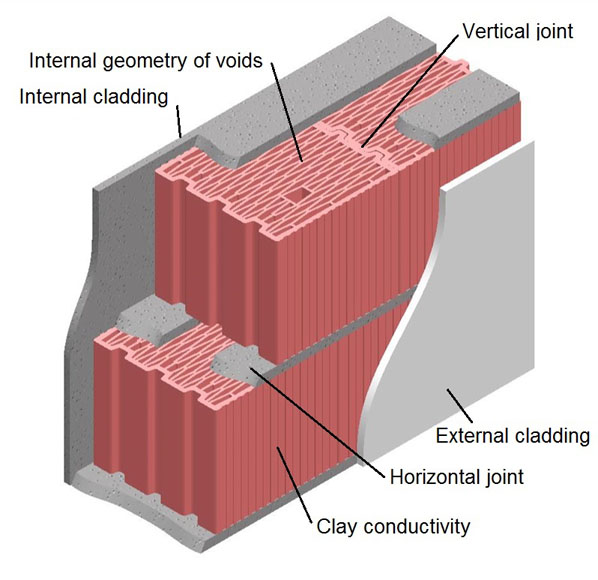
Those factors are the geometry of the block (internal voids and vertical joint), the execution of the wall (horizontal joint) and the thermal conductivity of clay.
This paper provides a comprehensive analysis of the various factors by making a comparative study of the equivalent thermal transmittance of the wall obtained with different geometries and different executions of the wall, depending on clay conductivity. Note that this parameter is the one on which it is easiest to act, by adding appropriate amounts of lightening additive in the manufacturing process.
Our findings reveal that a percentage decrease in clay conductivity produces a linear percentage reduction in the thermal transmittance of the wall, regardless of the type of block and wall mounting. In particular, a 50% decrease in the thermal conductivity of the clay leads to a 20% reduction in the equivalent thermal transmittance of the wall.
An equation has been obtained that enables the decrease in the equivalent thermal transmittance of a wall when the thermal conductivity of the clay is decreased to be estimated with an error of less than 3%.