Advances in Engineering Advances in Engineering features breaking research judged by Advances in Engineering advisory team to be of key importance in the Engineering field. Papers are selected from over 10,000 published each week from most peer reviewed journals.

H. Allmaier, C. Priestner, F.M. Reich, H.H. Priebsch, C. Forstner, F. Novotny-Farkas
Tribology International, Volume 48, April 2012
Abstract
Within the framework of an attempt to predict friction in journal bearings reliably and accurately, the impact of neglecting the hydrodynamic pressure dependence of the lubricant in the oil-model employed in the simulation is investigated. To this task calculations are carried out with two different oil-models; namely, an extensive oil-model that includes the influence of the hydrodynamic pressure on the lubricant properties, as well as the still commonly used basic oil-model that neglects this dependence. To cover full film lubrication and mixed lubrication with significant metal–metal contact, two different lubricants (SAE40, SAE10) are studied.
Calculations are conducted using a validated simulation model for dynamic loads with a maximum of up to 76 MPa that exceed typical main bearing loads found in current automotive ICEs. The results for both oil-models are compared to measurements performed on a journal bearing test rig.
We find that the results obtained with both oil-models agree closely with the experimental values only for full film lubrication, while solely the extensive oil-model is able to give also reliable results for the case of mixed lubrication.
Go to Journal
Additional Information:
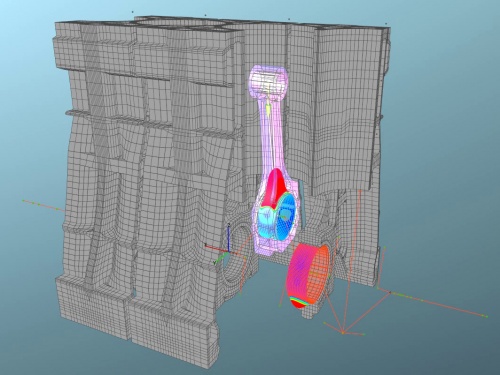
This paper is part of a series presenting a simulation method suitable to predict accurately and reliably friction power losses in journal bearings as they are commonly used in internal combustion engines. As illustration, the plot shows the hydrodynamic pressures occurring in the journal bearings of the crank train for a four cylinder inline engine shortly after ignition. The proposed model is suitable for full film as well as for mixed lubrication conditions.
The results obtained from this method are compared in detail to a large range of experimental data that were measured on a journal bearing test rig for different dynamic loads, different journal speeds and different lubricant classes. From this comparison one finds very close agreement for all cases studied.
Using this simulation model the importance of the pressure dependent lubricant properties are investigated in this paper for typical operating conditions as well as for a severe bearing durability test with a significant amount of mixed lubrication.
For additional information please get in touch with the author.
Further reading: Tribology International 44 (2011) 1151-1160, MTZ 4 (2012) 310-315, Tribology International 46 (2012) 200-207, or for a more complete overview our chapter on friction in automotive engines in the upcoming book ‘Tribology in Engineering’ by Intech, ISBN 980-953-307-460-8.
About the Virtual Vehicle Competence Center (ViF)
VIRTUAL VEHICLE is an international research center located in Graz/Austria that focuses on vehicle development and future vehicle concepts for road and rail. With over 200 employees, we collaborate with more than 100 national and international partners from science and industry. Our expertise is paving the way for the efficient development of affordable, safe and environmentally friendly vehicles.