Advances in Engineering Advances in Engineering features breaking research judged by Advances in Engineering advisory team to be of key importance in the Engineering field. Papers are selected from over 10,000 published each week from most peer reviewed journals.

Acta Astronautica, Volume 79, October–November 2012, Pages 33-43
Alfred E. Lynam, James M. Longuski
Purdue University, School of Aeronautics and Astronautics, 701 W. Stadium Ave. West Lafayette, IN 47907-2045, United States
Abstract
Multiple-satellite-aided capture employing gravity assists of more than one Galilean moon can help capture a spacecraft into orbit about Jupiter. Each additional moon flyby reduces the propulsive {DELTA}V required for Jupiter capture. While the existence of these trajectories has been demonstrated deterministically, the challenges associated with actually navigating a spacecraft through several close flybys in rapid succession are nontrivial. This paper addresses these navigation challenges by using simulated observations to estimate a spacecraft’s orbit as it approaches Jupiter and by targeting trajectory correction maneuvers to guide the spacecraft through multiple-satellite-aided capture sequences. Results indicate that radiometric navigation alone can easily provide safe double-satellite-aided capture sequences using a ballistic strategy, i.e. without any trajectory correction maneuvers (TCMs) in between flybys. However, triple-satellite-aided capture sequences require the operational capacity to target TCMs in between flybys in order to be feasible.
Figure legend
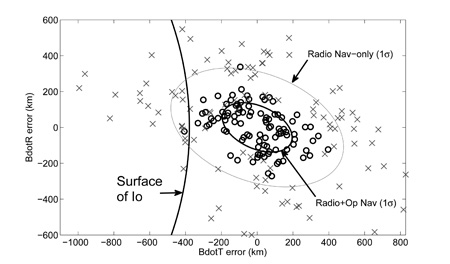
Io B-plane results for ballistic navigation strategies for CGIJ triple-satellite-aided capture sequences. The bold circles represent the B-plane results for combined optical and radiometric navigation. The X’s represent the B-plane results for only radiometric navigation. Even with combined radiometric and optical navigation, these results indicate an unacceptable level of risk (1 crash in 100 flybys). Thus, autonomous navigation must be used for triple flyby sequences.