Advances in Engineering Advances in Engineering features breaking research judged by Advances in Engineering advisory team to be of key importance in the Engineering field. Papers are selected from over 10,000 published each week from most peer reviewed journals.

Applied Surface Science, Volume 287, 15 December 2013, Pages 195-202.
Mayo Uehira, Masahiro Okada, Shoji Takeda, Naoyuki Matsumoto.
Graduate School of Dentistry, Department of Orthodontics, Osaka Dental University, 8-1 Kuzuha-Hanazono, Hirakata, Osaka 573-1121, Japan and
Department of Biomaterials, Osaka Dental University, 8-1 Kuzuha-Hanazono, Hirakata, Osaka 573-1121, Japan.
Abstract
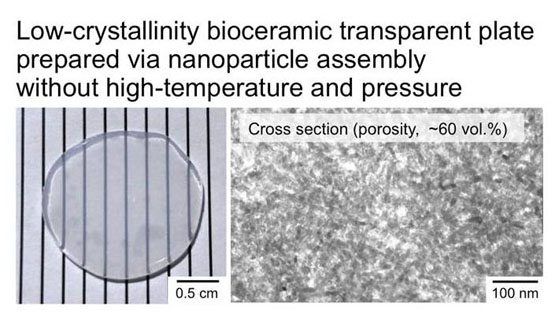
We examined the conditions for preparing nanoporous hydroxyapatite (HAp) plates and granules by assembling low-crystallinity HAp nanoparticles without template/binder molecules or high-temperature/pressure treatments. We first prepared HAp nanoparticles with different particle sizes and then the nanoporous plate or granule was prepared by drying an aqueous dispersion of HAp nanoparticles on an oil substrate. The hydrophobic oil substrate was preferable to prevent crack formation in HAp plates. The size of the HAp plate could be controlled by the concentration of HAp dispersion, and millimeter-sized granules were obtained by drying a small volume of HAp dispersion on/in the oil substrate. The nanoparticle-assembled HAp had nanosized pores, and the pore size could be changed by adjusting the size of the HAp nanoparticles used. It was found that both hydrophilic and hydrophobic liquids could infiltrate inside the nanopores. The nanoporous HAp granules also could adsorb and release proteins, and the protein adsorption and release delayed in the presence of the nanopores.
Additional Information:
Hydroxyapatite (HAp) exhibits excellent cell adhesion because of favorable adsorption capacity of its surface for bioactive substances such as cell-adhesive proteins. Although transparent HAp ceramics are prepared via a high-temperature and high-pressure sintering process, their composition and structure have limited variety, and are largely different from natural bone apatite. In this study, a low-crystallinity transparent HAp was developed via a low-temperature nanoparticle assembly. The low-crystallinity transparent HAp developed here had nanosized pores among the particles, and showed low crystallinity with high surface area, which is largely different from the conventional transparent HAp sintered ceramics. Cell adhesion and proliferation on the low-crystallinity transparent HAp could be directly observed with an optical microscope, and significantly influenced by the nanostructure of the transparent HAp.