Advances in Engineering Advances in Engineering features breaking research judged by Advances in Engineering advisory team to be of key importance in the Engineering field. Papers are selected from over 10,000 published each week from most peer reviewed journals.

Significance Statement
Printable electronics has emerged as a key field to meet the requirements large area, cost efficient production. Versatile electronic building blocks such as transistors, diodes and resistors are already available as printed counterparts of conventional semiconductor elements. However, printable electronic sensors and contactless switches operating in combination with magnetic fields were not available. The fabrication of printable magnetoelectronics is challenging, mainly due to the lack of appropriate sensing compounds at ambient conditions.
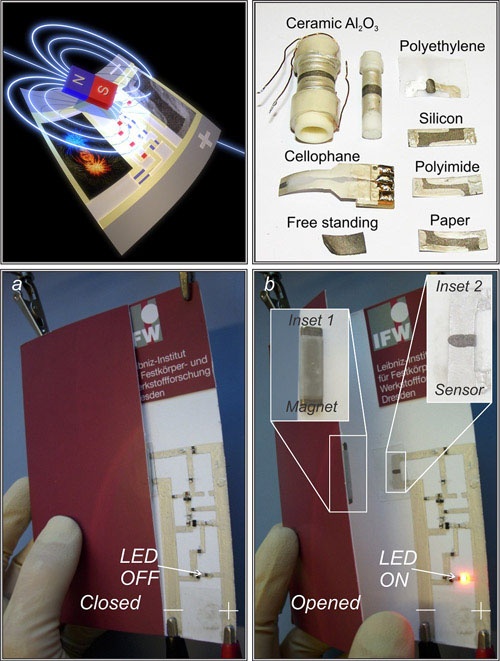
In our work we developed magneto-sensitive inks which are adherent to any kind of arbitrarily shaped surface. The preparation process uses standard sputter deposition, milling and mixing machines for high yield production, demonstrating the suitability of the printable devices for large scale industrial production. The transfer of the magnetic sensor to different substrates was realized by regular painting, although there are no limitations to use other conventional printing methods.
By adding a magnetic sensor to printable electronic circuitry, active intelligent packaging, post cards, books or promotional materials that communicate with the environment could be envisioned. The printable magnetic sensor would act as a contactless switch in a complex electronic circuit consisting of, i.e. transistors, capacitors and batteries. Combined with RFID tag and printed antenna, integrated functions of the printed electronic circuit such as data exchange can be externally triggered by a magnetic field. Our demonstrator with a magnetic switch printed on a postcard suggests that this vision on interactive fully printable electronics can become reality.
Copyright © 2012 WILEY-VCH Verlag GmbH & Co. KGaA, Weinheim.
Journal Reference
Daniil Karnaushenko, Denys Makarov, Chenglin Yan, Robert Streubel, Oliver G. Schmidt. Advanced Materials, Volume 24, Issue 33, page 4465, August 28, 2012.
Institute for Integrative Nanosciences, IFW Dresden, Helmholtzstraße 20, Dresden, 01069 Germany.
Material Systems for Nanoelectronics, Chemnitz University of Technology, Straße der Nationen 62, Chemnitz, 09107 Germany.
Email: Denys Makarov ([email protected]).
Abstract
The first printable magnetic sensor that relies on the giant magnetoresistance effect (GMR) is fabricated. The magnetic ink can be painted on virtually any substrate such as paper, polymers, ceramics, and glass and exhibits a room-temperature GMR of up to 8%. The functionality of a magnetic switch printed on a postcard paves the way for interactive and fully printable electronics. Further details can be found on page 4518 in the article by D. Makarov and co-workers.