Advances in Engineering Advances in Engineering features breaking research judged by Advances in Engineering advisory team to be of key importance in the Engineering field. Papers are selected from over 10,000 published each week from most peer reviewed journals.

Significant Statement
Our work in this research is limited to a simulation based study. In contrast to previous studies, our objective in this work does not include devising a novel protocol. But rather, we intend to demonstrate through discrete event simulation how QoS can be undertaken to support real-time multimedia traffic such as IPTV over an arbitrarily network such as VANETs, by efficient utilization of the existing protocols. And so in this work, we describe some QoS that can be applied to characterise the operation of vehicular network, and how these metric particularly apply to IPTV quality service provisioning. We outlined how Media Delivery Index (MDI) as an objective QoS metric can be applied to obtain information on network conditions, and how, using these information’s can help in shaping network parameters to optimize service flows. Furthermore, we established in this study how delay, jitter and packet loss can be minimised to a minimum such that can insure good quality IPTV delivery over an ever dynamic network such as VANETs
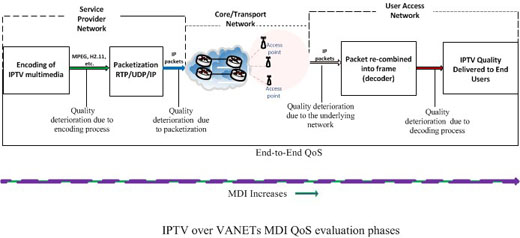
Figure Legned: The images illustrate the architectural design of IPTV services over VANETs, IPTV over VANETs QoS valuation phases, and the MDI: DF values of nodes at the speed of 72km/her with regard to the total packet loss.

Journal Reference
Wireless Networks, 2015, Volume 21, Issue 1, pp 315-328. Michael Oche, Rafidah Md Noor, Ali Jalooli.
Mobile Ad Hoc Research Lab, Faculty of Computer Science and Information Technology, University of Malaya, Kuala Lumpur, Malaysia.
Abstract
In order to deliver a qualitative Internet Protocol Television (IPTV) service over vehicular ad hoc networks (VANETs), a quality of service (QoS) mechanism is needed to manage the allocate of network resources to the diverse IPTV application traffic demands. Unlike other mobile network, VANETs have certain unique characteristic that presents several difficulties in providing an effective QoS. Similarly, IPTV requires a constant stream for QoS which at the moment is quite difficult due to the inherent VANET characteristics. To provide an effective QoS that will meet the IPTV application service demands, VANETs, must satisfy the compelling real-time traffic streaming QoS requirement (i.e., minimum bandwidth allocation, packet loss and jitter). In this report, we evaluate via simulation the feasibility of deploying quality IPTV services over VANETs, by characterizing the association between the IPTV streaming quality determining factors (i.e., throughput, delay, loss, jitter) and the IPTV quality degradation, with respect to node density and node velocity. Furthermore, we used an objective QoS metric (Media-Delivery-Index) to identify, locate and address the loss or out-of-order packet. We outline how, using these information’s can support in shaping network parameters to optimize service flows. The implementation assures a priority for handling IPTV traffic, such that maximise the usage of VANETs resources, and opens the possibility that loss and delay can be minimised to a degree that could guarantee quality IPTV service delivery among vehicle in a vehicular network system.