Advances in Engineering Advances in Engineering features breaking research judged by Advances in Engineering advisory team to be of key importance in the Engineering field. Papers are selected from over 10,000 published each week from most peer reviewed journals.

Significance Statement
Despite advances in molecular diagnostics, phenotypic results remain essential, especially due to the ever increasing presence of antimicrobial resistance in healthcare-acquired infections and in foodborne illnesses. Since phenotypic information is still crucial, the objective of this work was to combine the robustness and cost-effectiveness of traditional bacterial culture, with the speed of molecular diagnostic methods using self-assembled sensors. With concentrations as low as 5000 CFU/mL, the growth of pathogenic Escherichia coli O157:H7 was detected in 91 ± 4 min (51 min instrument time), which is on par with reported real-time PCR times for food microbiology testing. Results were obtained using a 48 sensor prototype device that accepted standard well plates. A sensor with the reported rapid growth monitoring capabilities could dramatically improve the detection time and sensitivity in applications that require rapid phenotypic information, such as with patient samples and food testing.
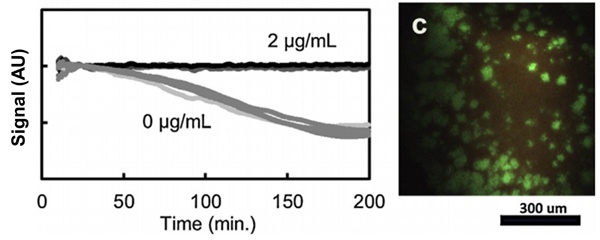
Caption: The signal of a self-assembled sensors, with 5000 CFU/mL E. coli in 0 ug/mL and 2 ug/mL gentamicin antibiotic. Two ug/mL of gentamicin is above the MIC, and therefore no growth is observed. (c) A fluorescent microscopy image of the self-assembled sensor confirming the viability of the bacteria. Microcolonies of bacteria can be seen as light areas in the image (after live/dead staining).
Journal Reference
Sensors and Actuators B: Chemical, Volume 190, 2014, Pages 265–269.
Paivo Kinnunen1, 2,, Maureen E. Carey3, Elizabeth Craig4, Sundaresh N. Brahmasandra5, Brandon H. McNaughton6
[expand title=”Show Affiliations”]1 Fibre and Particle Engineering Laboratory, University of Oulu, PO Box 3400, Oulu 90014, Finland and
2 Thule Institute, University of Oulu, PO Box 7300, Oulu 90014, Finland and
3 Rubicon Genomics, 4355 Varsity Drive, Suite E, Ann Arbor, MI 48108, United States and
4 NeuMoDx Molecular, Ann Arbor, MI 48108, United States and
5 Department of Emergency Medicine, University of Michigan, 2800 Plymouth Road, Ann Arbor, MI 48109, United States and
6 Michigan Center for Integrative Research in Critical Care (MCIRCC), University of Michigan, 2800 Plymouth Road, Ann Arbor, MI 48109, United States.
[/expand]
Abstract
Despite advances in molecular diagnostics, phenotypic results remain essential, especially due to the ever increasing presence of antimicrobial resistance in healthcare-acquired infections and in foodborne illnesses. Since phenotypic information is still crucial, the objective of this work was to combine the robustness and cost-effectiveness of traditional bacterial culture, and to approach the speed of molecular diagnostic methods. With concentrations as low as 5 × 10³ CFU/mL, the growth of pathogenic Escherichia coli O157:H7 was detected in 91 ± 4 min, which is on par with reported real-time PCR times used for food microbiology testing. Results were obtained using a 48 sensor prototype device that accepted standard well plates. A sensor with the reported rapid growth monitoring capabilities could dramatically improve the detection time and sensitivity in applications that require rapid phenotypic information, such as with patient samples and food testing.