Advances in Engineering Advances in Engineering features breaking research judged by Advances in Engineering advisory team to be of key importance in the Engineering field. Papers are selected from over 10,000 published each week from most peer reviewed journals.

Fang Wei, Bin Bai, Chih-Ming Ho
Biosensors and Bioelectronics Volume 30, Issue 1, 15 December 2011
Abstract
The sensitivity and detection time of an aptamer based biosensor for detecting botulinum neurotoxin (BoNT) depend upon the formation of proper tertiary architecture of aptamer, which closely correlates with the combinatorial effects of multiple types of ions and their concentrations presented in the buffer. Finding the optimal conditions for four different ions at 12 different concentrations, 20,736 possible combinations, by brute force is an extremely laborious and time-consuming task. Here, we introduce a feedback system control (FSC) scheme that can rapidly identify the best combination of components to form the optimal aptamer structure binding to a target molecule. In this study, rapid identification of optimized ionic combinations for electrochemical aptasensor of BoNT type A (BoNT/A) detection has been achieved. Only about 10 iterations with about 50 tests in each iteration are needed to identify the optimal ionic concentration out of the 20,736 possibilities. The most exciting finding was that a very short detection time and high sensitivity could be achieved with the optimized combinational ion buffer. Only a 5-min detection time, compared with hours or even days, was needed for aptamer-based BoNT/A detection with a limit of detection of 40 pg/ml. The methodologies described here can be applied to other multi-parameter chemical systems, which should significantly improve the rate of parameter optimization.
Additional Information
Systems that consist of a large number of interacting components and display self-organization capability toward emerging properties are commonly regarded as complex systems. All bio systems as well as many chemical and physical systems are complex systems. Due to the complexities and unknown self-organizing mechanisms, these complex systems unusually do not have governing equations for linking their interacting components with the system responses. In addition, the overall system performance frequently can be influences by large number of possible effectors. System optimization under this circumstance becomes non-trivial.
As a result of these challenges, attempts to understand and control a complex system using the conventional reductionist approach are formidable tasks. Unorthodox approaches are necessary for achieving the goal of guiding a complex system toward an optimized state. A “modeless” Feedback System Control (FSC) scheme was developed for this purpose.
The FSC platform is an experiment based technology by directly testing the various combinations of effectors to the complex system and measures the responses of complex system. This part of the FSC operation bases on experimental approach. Therefore, no modeling of the complex system is needed. FSC is assisted by a search algorithm for rapidly approaching the desired outcome.

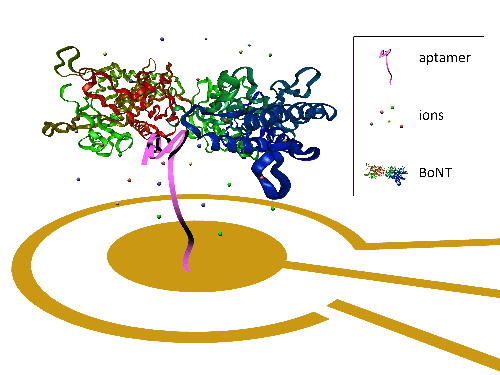
In the paper entitled “Feedback system control-based optimization for an electrochemical BoNT aptasensor”, we intended to optimize the folding of an aptamer probe (a chemical complex system) for detecting botulinum neurotoxin (BoNT). The objective functions are high signal to noise ratio and short detection time. The folding of aptamer is affected by the ions and their concentrations in the buffer. Four different ions, Na+, K+, Ca2+, and Mg2+ with 12 concentrations each, 124 = 20,736 combinations, were the input effector space. With only 10 feedback loops total of 48 combinations, we can shorten the detection time from 24 hours to 5 minutes at the same signal to noise ratio.
This is the first experiment demonstrating the effectiveness of applying FSC technique to optimize the performance of a chemical complex system, BoNT aptasensor. Optimization of multiple-component systems is a general and important topic in chemistry, such as combinational multiple precursors in a total synthesis, multiple metal/alloy/nanoparticle applications in catalysis, and parameter optimization during the bio sensing/regulation process. The FSC technique is expected to significantly facilitate researches in these areas. In fact, FSC has been demonstrated to be very effective in optimizing the combinatorial drugs for eradicating cancers, inhibiting viral infections and maintaining human embryonic stem cells.
Go to Journal