Advances in Engineering Advances in Engineering features breaking research judged by Advances in Engineering advisory team to be of key importance in the Engineering field. Papers are selected from over 10,000 published each week from most peer reviewed journals.

Zhi Liang, Hai-Lung Tsai
International Journal of Heat and Mass Transfer, Volume 55, Issues 11–12, May 2012
Abstract
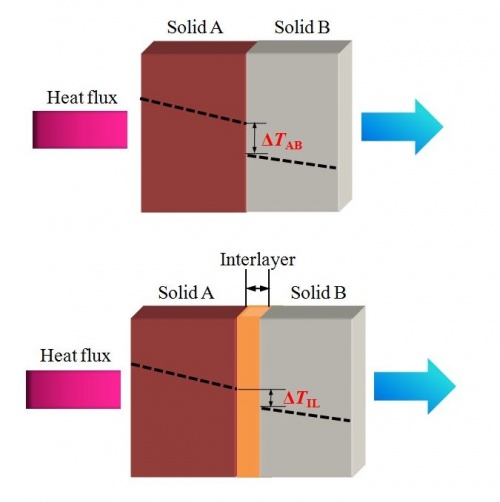
An effective method is proposed to greatly improve the thermal transport across the interface between two solids with dissimilar phonon spectra. If the two solids have similar crystal structure and lattice constant, it is predicted from the molecular dynamics modeling that an over 50% reduction of the thermal boundary resistance can be achieved by inserting a 3-unit-cell-thick interlayer whose Debye temperature is approximately the square root of the product of the Debye temperatures of the two solids. On the other hand, if the two solids have a large difference in lattice constant, it is found the interfacial atomic restructuring plays an important role in thermal transport. In order to effectively reduce the thermal boundary resistance, the interlayer should have a lattice constant near the average of the lattice constants of the two solids. For this case, an over 60% reduction of the thermal boundary resistance can be achieved if the Debye temperature of the interlayer is equal to or slightly higher than the square root of the product of the Debye temperatures of the two solids. The enhancement of thermal transport is found mainly due to more phonon states participating in the boundary transport by inserting an interlayer.
Additional Information:
Thermal management is a serious issue in the application of nanostructures. In micro/ nanodevices such as computer processors or semiconductor lasers, it is necessary to transport heat from the core of the device to an external heat sink as efficiently as possible. Due to the high surface–to–volume ratio in nanostructured components, thermal transport across the interface often dominates the overall thermal behavior. Reduction of thermal boundary resistance is, therefore, an explicit way to enhance the overall heat transport efficiency. Materials such as Si, Ge, SiO2 and GaAs are widely used in advanced semiconductor devices. These materials may have differences in both crystal structure and Debye temperature. It is shown in this paper that the thermal boundary resistance can be significantly reduced by inserting an interlayer between the two solids.
Go to Journal