Advances in Engineering Advances in Engineering features breaking research judged by Advances in Engineering advisory team to be of key importance in the Engineering field. Papers are selected from over 10,000 published each week from most peer reviewed journals.

Surface and Coatings Technology, Volume 234, 15 November 2013, Pages 42-47.
O. Levasseur1, L. Stafford1, N. Gherardi2, 3, 4, 5, 6, N. Naudé2, 3, 4, 5,6, E. Beche7, J. Esvan8, P. Blanchet9, B. Riedl9, A. Sarkissian10
[expand title=”Show Affiliations”]1 Département de Physique, Université de Montréal, Montréal, QC H3C 3J7, Canada and
2 Université de Toulouse, F-31062 Toulouse Cedex 9, France and
3 UPS, F-31062 Toulouse Cedex 9, France and
4 INPT, F-31062 Toulouse Cedex 9, France and
5 LAPLACE, F-31062 Toulouse Cedex 9, France and
6 CNRS, F-31062 Toulouse Cedex 9, France and
7 PROMES-CNRS/UPR 8521, Centre du four solaire Felix TROMBE, Odeillo, 66120 Font-Romeu, France
8 CIRIMAT-ENSIACET, 31030 Toulouse Cedex 4, France and
9 FPInnovations – Division des Produits du Bois, Québec, QC G1P 4R4, Canada and
10 Centre de Recherche sur le Bois, Université Laval, Québec, QC G1K 7P4, Canada and
11 Plasmionique, Varennes, QC J3X 1S2, Canada
[/expand]Abstract
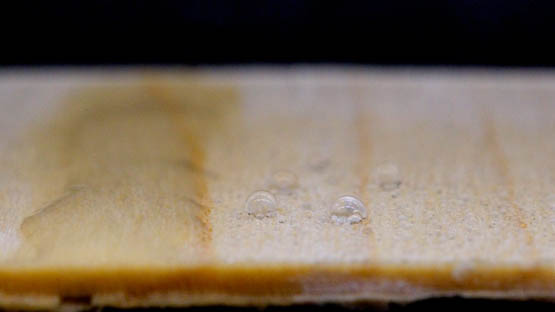
This work examines the influence of substrate outgassing on the deposition dynamics of either hydrophilic or hydrophobic coatings on wood surfaces in organosilicon, dielectric barrier discharges. Sugar maple and black spruce wood samples were placed on the bottom electrode and the discharge was sustained in N2–HMDSO (hexamethyldisiloxane) gas mixtures by applying a 24 kV peak-to-peak voltage at 2 kHz. Current–voltage characteristics revealed a transition from a filamentary to a homogeneous discharge with increasing plasma treatment time, t. Based on optical emission spectroscopy, the filamentary behavior was ascribed to the release of air and humidity from the wood substrate following discharge exposure which produced significant quenching of N2 metastables. This effect vanished at longer treatment times due to the nearly complete “pumping” of products from the wood substrate and the progressive deposition of a “barrier” layer. Analysis of the surface wettability through static, water contact angles (WCAs) and of the surface composition through Fourier-Transform-Infra-Red-Spectroscopy and X-ray-Photoelectron-Spectroscopy indicated that for t < 10 min, the wood surface was more hydrophilic due to the formation of a SiOx layer, a typical behavior for HMDSO deposition in presence of oxygen. On the other hand, for t > 10 min, the static WCA increased up to ~ 140° due to the deposition of hydrophobic Si(CH3)3-O-Si(CH3)2, Si(CH3)3, and Si(CH3)2 functional groups.