 Advances in Engineering Advances in Engineering features breaking research judged by Advances in Engineering advisory team to be of key importance in the Engineering field. Papers are selected from over 10,000 published each week from most peer reviewed journals.

Significance Statement
Imagine you are pushing a block over a smooth surface (let’s say a wooden box in your garage) and you measure the friction needed for sliding that block. Now take a second, identical block, attach it firmly side-by-side to the first block and push the two of them together. Intuitively you would expect that twice the pushing force is needed to slide this double-block object, and that is exactly what any scientists or engineer will tell you.
Recent experiments of sliding metallic particles on an atomically flat surface have now shown that this simple linear friction scaling can break-down at the nanoscale. For disordered interfaces it was unambiguously prooven that the friction-area scaling is sub-linear, or more precisely that friction scales with the square root of the area. With respect to the simple example from above, the sliding force of the double-block object would not be twice but about 1.4 times the friction of each of the two identical original blocks. This difference may not sound much, but if one block is actually one atom and you scale this up to macroscopic dimensions this effect is dramatic, and was therefore termed ‘structural lubricity’ or also ‘superlubricity’.
The reason for this counter-intuitive behavior can be easily understood: If the atomic lattices at the interface between the surface and the sliding block do not match, i.e., they are incommensurate, the atomic potentials can not interlock and the friction per unit area is proposed to vanish completely for infinitely large surfaces. For finite surfaces theory predicts different sub-linear scaling laws, depending on the precise atomic lattice constants and particle shapes. For example, disordered surfaces should exhibit a scaling law where friction is proportional to the square root of the contact area, exactly what is found experimentally for amorphous Antimony particles. Slightly modified, but still sub-linear scaling laws are predicted for crystalline interfaces, also consistent with the results of sliding Gold particles.
Sub-linear friction-area scaling has long been proposed but never experimentally verified, since it is extremely difficult to measure the friction between atomically defined interfaces. The new approach of pushing nanoparticles is capable to produce those defined interfaces, to quantify the contact area, and to provide the necessary reproducibility of those measurements. Sub-linear friction-area scaling is a key concept to obtain superlow friction surfaces for larger and realistically sized contacts, a concept valuably for any scientist or engineer involved in the interdisciplinary fields of friction and lubrication.
Figure Legend
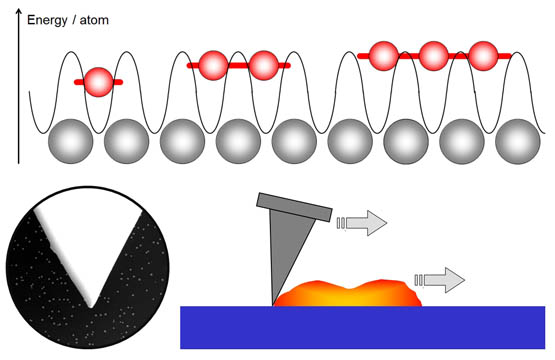
Top: Concept of structural lubricity – the structural mismatch between particle (red) and substrate (gray) results in a decreasing energy barrier per atom, and ultimately leads to a sublinear increase of friction with particle size
Bottom: Scanning Electron Microscopy image of the AFM tip interacting with antimony nanoparticles (left) and an illustration of the nanomanipulation process, where the torsion of the tip is proportional to the friction between particle and substrate.
Dietzel D1, Feldmann M1, Schwarz UD2, Fuchs H3, Schirmeisen A1.
Phys Rev Lett. 2013 Dec 6;111(23):235502.
1Institute of Applied Physics (IAP), Justus-Liebig-Universität Giessen, 35392 Giessen, Germany.and
2Department of Mechanical Engineering and Materials Science and Center for Research on Innovative Structures and Phenomena (CRISP), Yale University, New Haven, Connecticut 06520-8284, USA.and
3Physikalisches Institut and Center for Nanotechnology (CeNTech), Westfälische Wilhelms-Universität Münster, 48149 Münster, Germany.
Abstract
“Structural lubricity” refers to a unique friction state in which two flat surfaces are sliding past each other with ultralow resistance due to incommensurate atomic lattice structures. In this case, theory anticipates sublinear scaling for the area dependence of friction. Here, we experimentally confirm these predictions by measuring the sliding resistance of amorphous antimony and crystalline gold nanoparticles on crystalline graphite. For the amorphous particles a square root relation between friction and contact area is observed. For crystalline gold particles we find a more complex scaling behavior related to variations in particle shape and orientation. These results allow us to link mesoscopic friction to atomic principles.