Advances in Engineering Advances in Engineering features breaking research judged by Advances in Engineering advisory team to be of key importance in the Engineering field. Papers are selected from over 10,000 published each week from most peer reviewed journals.

Significance statement
Graphene oxide (GO) can be functionalized through both covalent and non-covalent bonding; thereby making graphene oxide an important building block for the synthesis of new materials. Prof. Tifeng Jiao from Yanshan University demonstrated the formation of nanostructured organogels based on self-assembly of cationic amphiphile-GO composites in common organic solvents. Three used cationic compounds contained different ammonium or pyridinium headgroups in molecular structures, which showed distinct π-π stacking and spatial hindrance in self-assembly process. Interestingly, it is found that nanostructures differ in different organic solvents as evidenced by morphological and spectral studies. The diversity of nanostructures in the organogels results from the variation of headgroups of amphiphiles coupled to GO. Furthermore, the mechanism associated with nanostructural formation is proposed. Soft matters fabricated through the gelation of amphiphile-GO might offer a good alternative for design and development of GO-based materials and devices. Therefore, the present work might renew interest and provide useful exploration in the design of self-assembled GO composites and soft matters in future.
Figure Legend
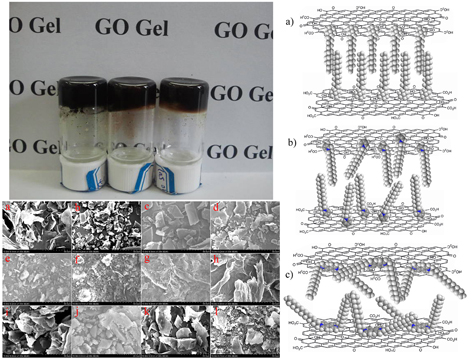
Photograph showed organogels of BPy-GO in solvents of DMF, cyclopentanone, and THF (from left to right). SEM images of xerogels from various solvents. Scheme demonstrated different assembly modes in cationic amphiphiles-graphene oxide gels.
Journal Reference
PLoS One, 2014 Jul 1;9(7):e101620.
Tifeng Jiao1,2,*, Yujin Wang1, Qingrui Zhang1,*, Xuehai Yan2,*, Xiaoqing Zhao1, Jingxin Zhou1, Faming Gao1
1 Hebei Key Laboratory of Applied Chemistry, School of Environmental and Chemical Engineering, Yanshan University, Qinhuangdao, China.
2 National Key Laboratory of Biochemical Engineering, Institute of Process Engineering, Chinese Academy of Sciences, Beijing, China.
Abstract
Self-assembly of hierarchical graphene oxide (GO)-based nanomaterials with novel functions has received a great deal of attentions. In this study, nanostructured organogels based on cationic amphiphile-GO composites were prepared. The gelation behaviors of amphiphile-GO composites in organic solvents can be regulated by changing the headgroups of amphiphiles. Ammonium substituted headgroup in molecular structures in present self-assembled composites is more favorable for the gelation in comparison to pyridinium headgroup. A possible mechanism for headgroup effects on self-assembly and as-prepared nanostructures is proposed. It is believed that the present amphiphile-GO self-assembled system will provide an alternative platform for the design of new GO nanomaterials and soft matters.