Advances in Engineering Advances in Engineering features breaking research judged by Advances in Engineering advisory team to be of key importance in the Engineering field. Papers are selected from over 10,000 published each week from most peer reviewed journals.

Significance Statement
This paper presents an analysis of the sensitivity and detection limit of silicon nanowire biosensors using an analytical model in combination with I-V and current noise measurements. The analysis shows that the limit of detection (LOD) and signal to noise ratio (SNR) can be optimized by determining an operating point in the depletion region with a large sensor transconductance, while maintaining a small system output noise amplitude. Both sensor and measurement configurations play equally important roles for optimal sensor performance. The analysis also shows that the LOD and SNR are minimally affected by the sensor cross-sectional geometry and size, but can be improved by increasing the surface to square root of volume ratio.
Figure Legend
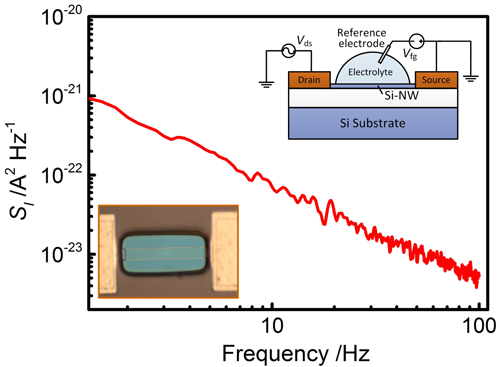
Current noise spectral density of a nanowire sensor in solution. Upper right insert: schematic representation of a typical nanowire sensor measurement configuration. Lower left insert: microscope image of packaged nanowire sensors.
Journal Reference
Songyue Chen1, Albert van den Berg1, Edwin T. Carlen1, 2. Sensors and Actuators B: Chemical, Volume 209, 2015, Pages 486–489.
[expand title=”Show Affiliations”]1 MESA+ Institute for Nanotechnology & MIRA Biomedical Technology and Technical Medicine, University of Twente, 7522 NH Enschede, The Netherlands.
2 Graduate School of Pure and Applied Science, University of Tsukuba, 305-8573 Tsukuba, Japan.
Corresponding authors: [email protected] (tel: +31 53489 4851) and [email protected]. [/expand]
Abstract
This paper presents an analysis of the sensitivity and detection limit of silicon nanowire biosensors using an analytical model in combination with I–V and current noise measurements. The analysis shows that the limit of detection (LOD) and signal to noise ratio (SNR) can be optimized by determining an operating point in the depletion region with a large sensor transconductance, while maintaining a small system output noise amplitude. Both sensor and measurement configurations play equally important roles for optimal sensor performance. The analysis also shows that the LOD and SNR are minimally affected by the sensor cross-sectional geometry and size.