 Advances in Engineering Advances in Engineering features breaking research judged by Advances in Engineering advisory team to be of key importance in the Engineering field. Papers are selected from over 10,000 published each week from most peer reviewed journals.

Significance Statement
Electrorheological (ER) suspensions, consisting of polarizable particles dispersed in electrically insulating oil, are important smart fluids with electrically tunable rheology. Carbonaceous particles are types of important dispersed phases of electro-responsive ER suspensions. But carbonaceous particles, in particular with nano-order size, are easy to aggregate in oils. This characteristic limits the application of carbonaceous based ER suspensions. We here develop silicone-grafted carbonaceous nanotubes (CTs) by grafting oxidized carbonaceous nanotubes with epoxy-terminated silicone. The silicone-grafted CTs in silicone oil shows improved wettability in silicone oil and decrease the re-aggregation of CTs. As a result, the suspension of silicone-grafted CTs possesses high dispersion stability, low zero-field viscosity, and high field-induced ER efficiency.
Figure Legend:
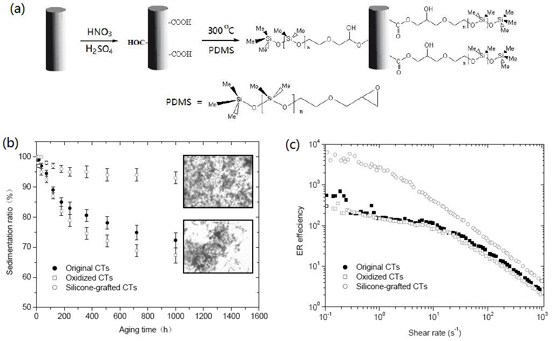
Upper panel: (a) Schematic preparation process of the silicone-grafted CTs.
Lower panel: (b) sedimentation curves of original CTs, oxidized CTs, and silicone-grafted CTs in silicone oil (T=25 oC, =10 vol%). After aging for 1000 h without stirred, the sedimentation ratio of the suspension of silicone-grafted CTs is ~94%, which is much higher than ~73% of the suspension of original CTs and ~68% of the suspension of oxidized CTs. The inset in (b) is the optical photo that shows the silicone-grafted CTs in silicone oil can maintain good disperse state after aging for 1000 h, while the original CTs tends to aggregate into cluster. (c) ER efficiency vs. shear rate for the suspensions of original CTs, oxidized CTs, and silicone-grafted CTs at 2 kV/mm of electric field (T=23 oC, =10 vol%). The ER efficiency of suspension of silicone-grafted CTs is ~40 at 100 s-1 and 2 kV/mm.
Journal Reference
Jianbo Yin, Xiaoxiao Wang and Xiaopeng Zhao. Nanotechnology 26 065704, 2015.
Smart Materials Laboratory, Department of Applied Physics, Northwestern Polytechnical University, Xi’an 710129, People’s Republic of China. E-mail: [email protected].
ABSTRACT
Carbonaceous particles are types of important fillers or dispersed phases of electro-responsive electrorheological (ER) suspensions. But carbonaceous particles, in particular with nano-order size, are easy to aggregate in oils. This characteristic limits the application of ER suspensions based on carbonaceous particles. In order to improve dispersion stability and ER efficiency, in this paper, we develop silicone-grafted carbonaceous nanotubes (CTs) by grafting oxidized carbonaceous nanotubes with epoxy-terminated silicone. The samples are characterized by Fourier transform infrared spectra, x-ray photoelectron spectroscopy, thermogravimetric analysis, and transmission electron microscopy. The wettability and dispersion stability of nanotubes in silicone oil are investigated by wetting curves and sedimentation tests. The ER properties of CTs when dispersed in silicone oil are measured by a rheometer under electric fields. It demonstrates that grafting with silicone can distinctly improve the wettability of CTs in silicone oil and decrease the re-aggregation of CTs. As a result, the suspension of silicone-grafted CTs in silicone oil shows high dispersion stability. Compared to the suspension of bare CTs, the suspension of silicone-grafted CTs exhibits lower zero-field viscosity but higher field-induced viscosity; thus it possesses higher ER efficiency. This enhanced ER efficiency is related to the improved wettability of silicone-grafted CTs in silicone oil.