Advances in Engineering Advances in Engineering features breaking research judged by Advances in Engineering advisory team to be of key importance in the Engineering field. Papers are selected from over 10,000 published each week from most peer reviewed journals.

Optics Express, Vol. 21, Issue 9, pp. 11448-11456 (2013).
Zhigang Zang, Atsushi Nakamura, and Jiro Temmyo.
Research Institute of Electronics, Shizuoka University, 3-5-1 Johoku, Hamamatsu, Shizuoka 432-8011, Japan
Abstract
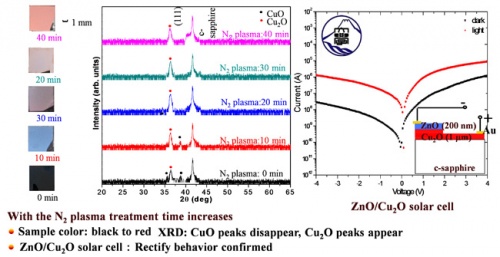
Cuprous oxide (Cu2O) films synthesis by radical oxidation with nitrogen (N2) plasma treatment and different RF power at low temperature (500°C) are studied in this paper. X-ray diffraction measurements show that synthesized Cu2O thin films grow on c-sapphire substrate with preferred (111) orientation. With nitrogen (N2) plasma treatment, the optical bandgap energy is increased from 1.69 to 2.42 eV, when N2 plasma treatment time is increased from 0 min to 40 min. Although the hole density is increased from 1014 to 1015 cm−3 and the resistivity is decreased from 1879 to 780Ωcm after N2 plasma treatment, the performance of Cu2O films is poorer compared to that of Cu2O using RF power of 0. The fabricated ZnO/Cu2O solar cells based on Cu2O films with RF power of 0 W show a good rectifying behavior with a efficiency of 0.02%, an open-circuit voltage of 0.1 V, and a fill factor of 24%.
© 2013 OSA
Additional Information
Dr. Zhigang Zang and co-workers from Shizuoka University(Japan) firstly report a novelty method of synthesizing high quality cuprous oxide (Cu2O) films by radical oxidation with nitrogen (N2) plasma treatment at low temperature (500°C). This method breaks the theory of Cu2O can only be synthesized above high temperature of 1000oC, which exhibits the advantage of low cost, high reproducibility and high efficiency. The morphological, crystal, and optoelectronic properties of the Cu2O have been investigated by different N2 plasma treatment times. X-ray diffraction measurements show that Cu2O thin films grow on c-sapphire substrate with preferred (111) orientation. The resistivity of the Cu2O thin films is decreased from 1879 to 780Ωcm after N2 plasma treatment. The fabricated ZnO/Cu2O solar cells based on Cu2O films show a good rectifying behavior. This high quality Cu2O film with low cost, high reproducibility and high efficiency has been considered as one of the third generation solar cell materials, and will play an important role in the semiconductor and energy area.