Advances in Engineering Advances in Engineering features breaking research judged by Advances in Engineering advisory team to be of key importance in the Engineering field. Papers are selected from over 10,000 published each week from most peer reviewed journals.

Computational Mechanics, Jan 2015, Volume 55, Issue 1, pp 27-35.
Daniel Schneider 1 , Stefan Schmid 1, Michael Selzer 1,2, Thomas Böhlke3, Britta Nestler1,2
- Institute of Materials and Processes, Karlsruhe University of Applied Science, Moltkestrasse 30, 76133, Karlsruhe, Germany and
- Institute of Applied Materials (IAM), Karlsruhe Institute of Technology, Kaiserstrasse 12, 76131, Karlsruhe, Germany and
- Institute of Engineering Mechanics, Chair for Continuum Mechanics, Karlsruhe Institute of Technology, Kaiserstrasse 12, 76131, Karlsruhe, Germany.
Abstract
A small strain plasticity model, based on the principles of continuum mechanics, is incorporated into a phase-field model for heterogeneous microstructures in polycrystalline and multiphase material systems (Nestler et al., Phys Rev 71:1–6, 2005). Thereby, the displacement field is computed by solving the local momentum balance dynamically (Spatschek et al., Phys Rev 75:1–14, 2007) using the finite difference method on a staggered grid. The elastic contribution is expressed as the linear approximation according to the Cauchy stress tensor. In order to calculate the plastic strain, the Prandtl–Reuss model is implemented consisting of an associated flow rule in combination with the von Mises yield criterion and a linear isotropic hardening approximation. Simulations are performed illustrating the evolution of the stress and plastic strain using a radial return mapping algorithm for single phase system and two phase microstructures. As an example for interface evolution coupling with elasto-plastic effects, we present crack propagation simulations in ductile material
Figure Legend:
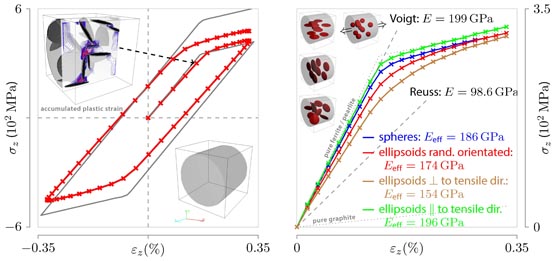
left: Stress-strain curves of cyclic loading simulations. Comparison of hystereses related to homogeneous (gray) and heterogeneous (red) material. right: Resulting stress-strain curves of heterogeneous microstructures with different configuration of inclusions in a cylindrical simulation domain.