Advances in Engineering Advances in Engineering features breaking research judged by Advances in Engineering advisory team to be of key importance in the Engineering field. Papers are selected from over 10,000 published each week from most peer reviewed journals.

Appl. Phys. Lett. 102, 243905 (2013).
Yunguo Li, Abir De Sarkar*, Biswarup Pathak, Rajeev Ahuja.
Applied Materials Physics, Department of Materials Science and Engineering, Royal Institute of Technology (KTH), S-100 44 Stockholm, Sweden and
Department of Physics, Central University of Rajasthan, NH-8, Bandarsindri, Rajasthan 305801, India and
Department of Chemistry, Indian Institute of Technology, Indore 452017, India and
Condensed Matter Theory Group, Department of Physics and Astronomy, Box 516, Uppsala University, S-75120 Uppsala, Sweden.
Current affiliation of the corresponding author (Abir De Sarkar): Institute of Nano Science and Technology, Habitat Centre, Phase-X, Sector-64, Mohali, Punjab – 160062, India.
Abstract
Strain effects on the stabilization of Al ad-atom on graphene oxide (GO) nanosheet as well as its implications for NH3 storage have been investigated using first-principles calculations. Tensile strain is found to be very effective in stabilizing the Al ad-atom on GO. It strengthens the C–O bonds through an enhanced charge transfer from C to O atoms. Interestingly, Al’s stability is governed by the bond strength of C-O rather than that of Al-O. Optimally strained Al-functionalized GO binds up to 6 NH3 molecules, while it binds no NH3 molecule in unstrained condition.
© 2013 AIP Publishing LLC
Additional Information
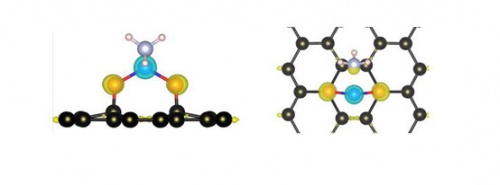
Carbon nanostructures were initially considered to be promising candidates for a large array of applications, e.g., energy storage, catalysis, molecular sensors, biomedicine, nanotechnology. However, in pristine form, they were found to be chemically inert, which necessitated their functionalization with metal dopant/ad-atoms in order to enable them for various practical applications. In this article, we have demonstrated the efficacy of strain in stabilizing the binding of metal ad-atoms to graphene oxide nanosheet. In strain-free condition, Al ad-atom is found to be unstable on graphene oxide nanosheet and the Al-functionalized graphene oxide nanosheet is unable to bind even a single NH3 molecule. However, under an optimal magnitude of mechanically applied strain, it is able to bind up to 6 NH3 molecules with good binding energies.
Figure Legend
Differential charge density plot of a single NH3 molecule adsorbed on optimally strained Al-functionalized graphene oxide nanosheet (Side and Top views)