Advances in Engineering Advances in Engineering features breaking research judged by Advances in Engineering advisory team to be of key importance in the Engineering field. Papers are selected from over 10,000 published each week from most peer reviewed journals.

G. Juárez Díaz, J. Díaz-Reyes, J. Martínez-Juárez, M. Galván-Arellano, J.A. Balderas-López
Materials Science in Semiconductor Processing, Volume 15, Issue 5, October 2012
Abstract
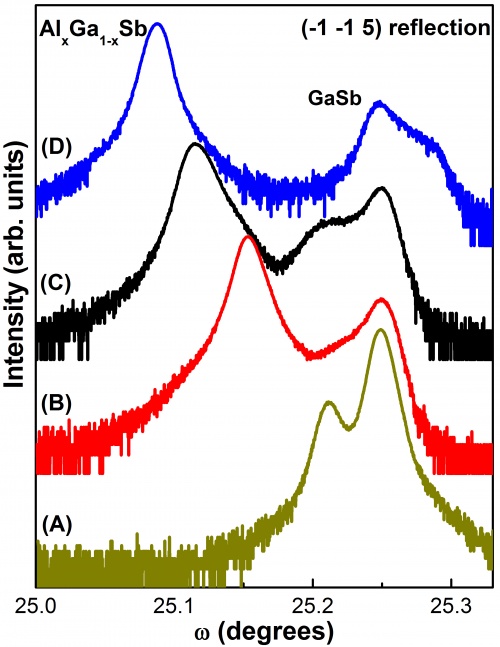
AlxGa1−xSb ternary solid solutions lattice-matched to the GaSb (001) substrate with composition in the range 0.05≤x≤0.2 were grown by liquid phase epitaxy. High resolution X-ray diffraction and Raman scattering techniques were applied to characterize AlxGa1−xSb alloys. The out of plane lattice parameter was estimated directly from the asymmetrical diffractions of planes (115) and (−1−15). The out of plane lattice parameter as a function of Aluminium content is higher than the corresponding bulk lattice parameter of AlxGa1−xSb layers obtained with Vegard’s law. These results show that some of the layers are more strained than others. Two peaks are observed in their Raman spectra over this composition range. The assignment of the observed modes to GaSb-like modes is discussed. The studies of the chemical composition of the layers by SIMS exhibit the presence of tellurium, carbon and oxygen like the main residual impurities.
Additional information:
Because of the corresponding wavelengths of the alloys of gallium antimonide- (GaSb-) based compound semiconductors cover a wide spectral range from 1.24 mm (AlGaSb or AlGaAsSb) to 4.3 mm (InGaAsSb), they have received increasing attention recently. Consequently, they became promising candidates for applications in long wavelength lasers and photodetectors for fibre optic communication systems. A lot of work has been performed to develop photodetectors which operate at 1.55 mm for application in optical communication systems. The AlxGa1-xSb compounds are the materials for such application. Thin film alloys of those compounds and deposited on GaSb substrates are commonly grown by liquid phase epitaxy (LPE) technique at temperatures over 450°C. However some problems arise when AlGaSb alloys are grown on GaSb substrates at those temperatures. One of them is that Al is a very oxidizing element and inhibits the deposition processand the other one is that at temperatures below 450°C, amounts of Al2O3 particles appear. These two factors make difficult the growth of the films and the purity of the layers deteriorates because the number of acceptors in the film is increased. The control of the acceptors is the key to reliable material for the most wanted application. A technique utilized to compensate the acceptors is adding tellurium in the liquid solution, however an intentional contamination demands changes in the concentration of precursors in the alloy and consequently a new calibration has to be set again. This fact may result in lattice mismatches between film and substrate.
In this work presents the study of AlxGa1-xSb ternary solid solutions lattice-matched to the GaSb (001) substrate with composition in the range 0.05 ≤ x ≤ 0.2 that were grown by liquid phase epitaxy. High resolution X-ray diffraction and Raman scattering techniques were applied to characterize AlGaSb alloys. The out of plane lattice parameter was estimated directly from the asymmetrical diffractions of planes (115) and (-1-15). The out of plane lattice parameter as a function of Aluminium content is higher than the corresponding bulk lattice parameter of AlxGa1-xSb layers obtained with Vegard’s law. These results show that some of the layers are more strained than others. Two peaks are observed in their Raman spectra over this composition range. The assignment of the observed modes to GaSb-like modes is discussed. The studies of the chemical composition of the layers by SIMS exhibit the presence of tellurium, carbon and oxygen like the main residual impurities.
Go to Journal