Advances in Engineering Advances in Engineering features breaking research judged by Advances in Engineering advisory team to be of key importance in the Engineering field. Papers are selected from over 10,000 published each week from most peer reviewed journals.

Appl. Phys. Lett. 102, 152406 (2013).
Ankit Kumar, Dinesh K. Pandya, Sujeet Chaudhary.
Thin Film Laboratory, Department of Physics, Indian Institute of Technology Delhi, New Delhi 110016, India.
Abstract
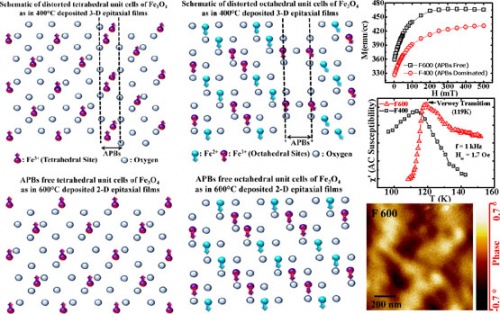
Epitaxial Fe3O4 thin films are deposited at 400, 500, 600 °C on TiN buffered Si(100) using reactive magnetron sputtering. In-situ reflection high energy electron diffraction confirmed thegrowth to be two-dimensional (2-D) at 500–600 °C and X-ray reflectivity revealed a sharp interface (∼0.4 nm). Growth temperature effect on structural, electronic, and magnetic behavior was probed by X-ray diffraction, Raman, and magnetization studies. Small value of deformation potential (0.19 eV/Å) and electron phonon coupling constant (0.71), sharp Verwey transition with large jump at 119 K in magnetization during field cooled warming and early saturation at 2.5 kOe affirmed the superior magnetic quality of epitaxial Fe3O4 samples.
Additional Information
A major step in developing next generation spintronic devices for information processing and communication sectors is the synthesis of two-dimensional (2-D) epitaxial ferromagnetic layers for use as spin-injectors and spin-filters. Half-metallic oxides are prime choice owing to their high Curie temperature and 100% spin polarization that is exhibited by Fe3O4 (a simple oxide) at room temperature along with other attractive features of high electrical conductivity and high saturation magnetization. Despite having strong spin device compatibility, the uses of Fe3O4 thin films are presently unexploited due to presence of certain growth defects, primarily the occurrence of stacking-faults at ionic-sites creating a magnetic disorder known as anti-phase boundaries (APBs). Such boundaries suppress the half-metallic character of this system owing to spin scattering from the anti-ferromagnetic (AF) coupled spins at the boundaries and have significant impact on its electronic and magnetic properties, like increase in resistivity, disappearance/broadening of the Verwey transition and delay in magnetic saturation. Therefore, to realize the devices out of Fe3O4 APBs free films are prime requirement. The APBs cause intra-grain AF couplings in epitaxial films by the super-exchange interaction at cationic/ionic sites. These AF interactions are believed to possess the high Gibbs free energy and therefore are diffusive in nature. Hence, an increase in the energy associated with the nucleation and/or early-stage of the growth with and corresponding increase in surface mobility of the ad-atoms is thus expected to play a critical role in the reduction of APBs. This novel approach of ad-atom mobility enhanced out-diffusion of APBs in layer-by-layer growth mode was the motive for the present work. To accomplish this task it was necessary to have high surface diffusion of ad-atoms at moderately high growth temperature with avoidance of interfacial diffusion from substrate. Thus the appropriate selection of substrate was pivotal to have APBs free 2-D Fe3O4 films. In addition it was intended to accomplish the growth on Si wafer for easy integration with existing semiconductor technology. Fe3O4 thin films were therefore deposited on TiN buffered Si(100) at 300-600°C and it was found that 500-600°C deposited films are not only 2-D epitaxial but also free form APBs. These films show large in-plane magnetic domains confirming the reduction of APBs and also possess the requisite near-bulk magnetic saturation of 461 emu/cc at low-field of 250 mT at room temperature. A sharp Verwey transition at 119K also supports APBs free device quality of these 5-50 nm thick films.