Advances in Engineering Advances in Engineering features breaking research judged by Advances in Engineering advisory team to be of key importance in the Engineering field. Papers are selected from over 10,000 published each week from most peer reviewed journals.

Optics Express, Vol. 21, Issue 16, pp. 19311-19323 (2013).
F. Doring, A.L. Robisch, C. Eberl, M. Osterhoff, A. Ruhlandt, T. Liese, F. Schlenkrich, S. Hoffmann, M. Bartels, T. Salditt, and H.U. Krebs
Institut fur Materialphysik, Universität Gottingen, Friedrich-Hund-Platz 1, 37077 Gottingen, Germany and
Institut fur Rontgenphysik, Universität Gottingen, Friedrich-Hund-Platz 1, 37077 Gottingen, Germany
Abstract
Compound optics such as lens systems can overcome the limitations concerning resolution, efficiency, or aberrations which fabrication constraints would impose on any single optical element. In this work we demonstrate unprecedented sub-5 nm point focusing of hard x-rays, based on the combination of a high gain Kirkpatrick-Baez (KB) mirror system and a high resolution W/Si multilayer zone plate (MZP) for ultra-short focal length f. The pre-focusing allows limiting the MZP radius to below 2 um, compatible with the required 5 nm structure width and essentially unlimited aspect ratios, provided by enabling fabrication technology based on pulsed laser deposition (PLD) and focused ion beam (FIB).
© 2013 OSA
Additional Information
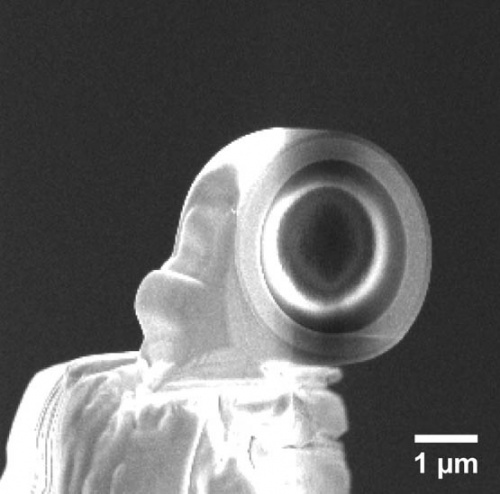
For the last decades there has been a tremendous rush in x-ray optics towards nano-focused beams, fuelled by the prospects of high resolution imaging, diffraction and spectroscopy at the nanoscale. Here we demonstrate a unique possibility to reach point focusing of hard x-rays (7.9 keV) down to less than 5 nm. One would guess that a sub 5 nm spot size would require brute force efforts inultra-precision fabrication of optical elements. We found that the way out of an unreasonably painful fabrication effort in order to reduce abberations was simply the optimized combination of more than a single focusing element. As is common practice in all other fields of optics, compound optical microscopes and notably objectives containing many different lenses compensate the respective defficiencies of each component. Here we show that a compound optics of an elliptical focusing mirror and a multilayer zone plate (MZP) can do the job for hard x-rays. For fabrication of the W/Si MZP a unique approach was used:a combination of pulsed laser deposition (PLD) and focused ion beam (FIB), which allows both highly precise layer thicknesses and damage free lens cutting.
Recently the 5 nm focus could be reproduced even for x-rays with 13.8 keV (M. Osterhoff et al., Proc. of SPIE 8848 (2013) 884802) using a W/ZrO2 MZP on a glass wire (see Figure).