Advances in Engineering Advances in Engineering features breaking research judged by Advances in Engineering advisory team to be of key importance in the Engineering field. Papers are selected from over 10,000 published each week from most peer reviewed journals.

Salomeh Tabatabaei, Ashavani Kumar, Haleh Ardebili, Peter J. Loos, Pulickel M. Ajayan
Microelectronics Reliability, May 2012
Abstract
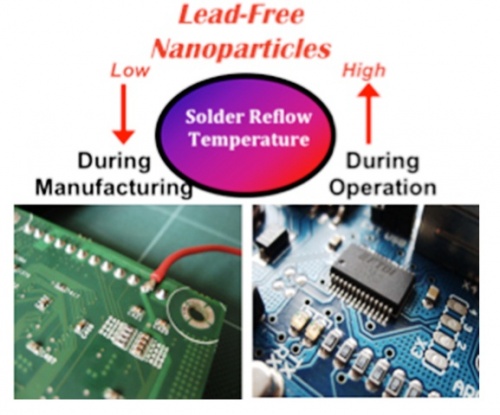
Au–Sn alloy nanoparticles (ANPs) with 16–67 wt% Sn were successfully synthesized in the size range of 2–10 nm using chemical reduction method. X-ray diffraction confirmed the formation of AuSn phase with hexagonal structure and was further validated by microscopy and spectroscopy techniques. Chemical reduction is a more scalable and economical technique relative to other synthesis methods for solder alloy particles; it can produce particles in nanoscale range and can be conducted at room temperature. A significant depression in the melting transition (starting from 187 °C) was observed for the Au–Sn ANPs relative to the bulk eutectic point (Tm = 280 °C at 30% Au). Au-Sn nanoparticles offer a unique set of advantages as lead-free soldering material. In nanoparticle state, they can reflow at lower temperatures leading to less thermal stresses in adjacent electronic components during the manufacturing process. After the initial reflow and solder joint formation (bulk state), they can reclaim bulk Au-Sn properties including permanent high melting temperatures (up to 420 °C) which can potentially lead to superior thermal and mechanical performance suitable for high temperature electronic applications such as military and aerospace.
Go to Journal