Advances in Engineering Advances in Engineering features breaking research judged by Advances in Engineering advisory team to be of key importance in the Engineering field. Papers are selected from over 10,000 published each week from most peer reviewed journals.

Applied Surface Science, Volume 282, 1 October 2013, Pages 478-486.
Sabina Markelj, Olga V. Ogorodnikova, Primoz Pelicon, Thomas Schwarz-Selinger, Iztok Cadez.
Jozef Stefan Institute and Association EURATOM-MESCS, Jamova cesta 39, SI-1000 Ljubljana, Slovenia and
Max-Planck-Institut fur Plasmaphysik, EURATOM Association, Boltzmannstr. 2, D-85748 Garching, Germany.
Abstract
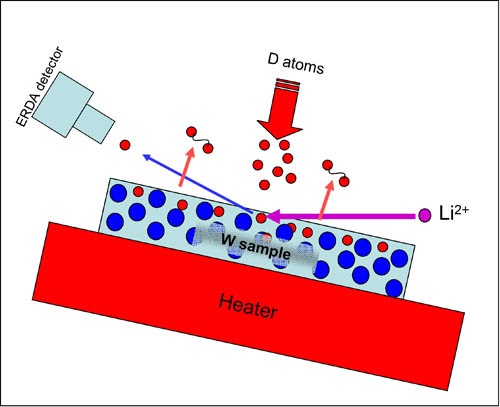
Temperature dependence of D atom adsorption on polycrystalline tungsten was studied by in situ ion beam method Elastic Recoil Detection Analysis (ERDA). A new procedure named thermoadsorption (TA) was developed for this study, where the sample is first exposed to a deuterium atom beam at high temperature and then, while being continuously exposed to the atom beam, is slowly cooled down. H and D concentrations are determined during this cooling by ERDA. A stepwise increase of the surface areal density was observed starting from (1.2 ± 0.3) × 1015 D cm−2 at sample temperature around 750 K, to (2.2 ± 0.3) × 1015 D cm−2 when temperature was around 600–500 K and final increase to (6.8 ± 0.6) × 1015 D cm−2 when sample temperature was below 440 K. From this, three individual binding states were identified for the studied polycrystalline tungsten. We present a numerical model adequate to our experimental procedure which was developed by taking into account all relevant surface processes. The binding energies for desorption/adsorption were derived by modeling the TA data with the numerical model and were determined to be: 1.05 ± 0.06 eV, 1.7 ± 0.08 eV and >2.2 eV. Isotope exchange at 485 K sample temperature was also measured and modeled. An estimate of the reflection coefficient for 0.2 eV hydrogen atoms on polycrystalline W was obtained from modeling the isotope exchange data and was determined to be 0.96 ± 0.02.
Additional information
Thermal deuterium atom adsorption on polycrystalline tungsten was studied in situ by high energy ion beam method Elastic Recoil Detection Analysis (ERDA). New procedure named thermoadsorption was used so that concentration of adsorbed deuterium is measured during sample cooling while it is continuously exposed to D atom beam. Both, D and H concentrations on the surface and bellow it are simultaneously followed by ERDA. It was observed that deuterium surface areal density is increasing stepwise, identifying three individual binding states for the studied polycrystalline tungsten. Surface areal density as a function of temperature and time are modeled according to specific experimental procedure and binding energies for desorption/adsorption were derived. The isotope exchange at fixed sample temperature of 485 K was also measured and modeled. From the measured data an estimate of the reflection coefficient for 0.2 eV hydrogen atoms on polycrystalline W was obtained.