Advances in Engineering Advances in Engineering features breaking research judged by Advances in Engineering advisory team to be of key importance in the Engineering field. Papers are selected from over 10,000 published each week from most peer reviewed journals.

Significance Statement
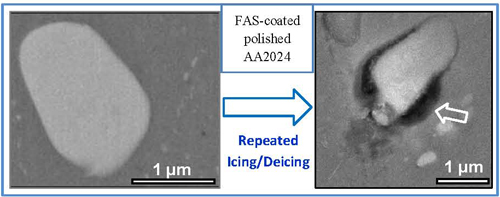
Up to date, numerous anti-icing (or icephobic) surfaces that use various organosilanes or fatty acids as toplayers have been actively developed by many research groups worldwide. Such molecules (mainly alkylsilanes, perfluoroalkylsilanes, and stearic acid) are believed to attach through chemical bonding and form densely packed monolayers on various metal (more precisely oxide) surfaces, making them water- (and ice-) repellent. The long-term performance of such layers against icing/deicing has not been evaluated. Through a series of subsequent icing/deicing tests repeated on polished aluminum (AA2024 alloy) grafted with heptadecafluorodecyl-trimethoxysilane (FAS), octadecyltrimethoxysilane and steric acid, this research work demonstrated that such monolayers slowly react with water/ice and deteriorate over icing/deicing events. Figure shows surface micrographs of FAS-grafted aluminum, both as-prepared (left) and subjected to tens of icing/deicing tests (right). The trench around an Al-Cu-Mg intermetallic particle in the right panel (shown by arrow) indicates the surface FAS layer slowly deteriorated after 33 icing/deicing cycles, which made local electrochemical corrosion processes possible. The finding implies that long-term chemical stability in contact with water/ice should be carefully evaluated in the future for all potential anti-ice materials.
Journal Reference
Soft Matter. 2015;11(5):856-61.
[expand title=”Show Affiliations”]1Institute of Innovative Science and Technology, Tokai University, Hiratsuka, Kanagawa 259-1292, Japan. [email protected].
2School of Engineering and Applied Science, Aston University, Birmingham B4 7ET, UK.
Abstract
This work analyzes the anti-icing performance of flat aluminum surfaces coated with widely used alkyl-group based layers of octadecyltrimethoxysilane, fluorinated alkylsilane and stearic acid as they are subjected to repeated icing/deicing cycles. The wetting properties of the samples upon long-term immersion in water are also evaluated. The results demonstrate that smooth aluminum surfaces grafted with alkyl groups are prone to gradual degradation of their hydrophobic and icephobic properties, which is caused by interactions and reactions with both ice and liquid water. This implies that alkyl-group based monolayers on aluminum surfaces are not likely to be durable icephobic coatings unless their durability in contact with ice and/or water is significantly improved.