Advances in Engineering Advances in Engineering features breaking research judged by Advances in Engineering advisory team to be of key importance in the Engineering field. Papers are selected from over 10,000 published each week from most peer reviewed journals.

Journal of Fluids and Structures, Volume 52, 2015, Pages 130–144.
Schiffer1, , V.L. Tagarielli2
1 Department of Mechanical Engineering, Khalifa University of Science, Technology and Research (KUSTAR), Abu Dhabi, UAE and
2 Department of Aeronautics, Imperial College London, London SW7 2AZ, UK.
Abstract
We present a new experimental technique to allow laboratory-scale observation of underwater blast loading on circular plates, including dynamic deformation and failure of the plates as well as the sequence of cavitation events in water. The apparatus is used to measure and compare the responses of a quasi-isotropic glass/vinylester composite and of a woven carbon/epoxy plate. Dynamic explicit FE simulations are conducted and their predictions are found in good agreement with experiments. Measurements and FE predictions are used to validate a recently developed theoretical model for the response of elastic orthotropic plates to underwater blast.
Go To Journal of Fluids and Structures
Significance statement
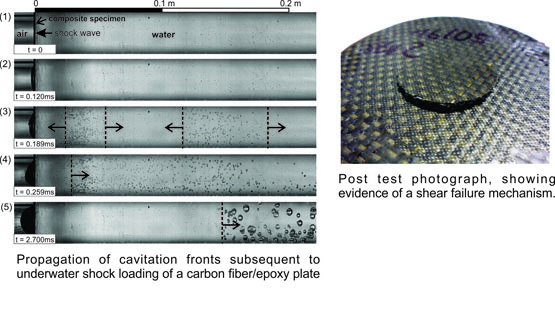
A major concern in the design of naval composite structures is their ability to withstand extreme loading conditions consequent to an explosion in water. The underwater detonation of an explosive charge gives rise to intense shock waves impinging on surrounding structures. The ensuing structural motion is strongly coupled to the motion of the fluid, leading to a tensile (rarefaction) wave to be radiated from the loaded surface. Such tensile wave can trigger cavitation if the pressure in the surrounding fluid drops below the vapour pressure. The cavitation zone spreads in the water with supersonic speed and manifests itself in form of rapidly growing and collapsing gas bubbles. Cavitation phenomena significantly affect wave propagation as well as structural loading and need to be thoroughly understood in order to design submerged structural components against underwater blast.
The response of composite structures to underwater blast is difficult to observe at laboratory scale and for this reason experimental studies have appeared only in the last decade. Recent studies on this subject focused on observation of deformation and failure modes, but did not attempt observing the cavitation processes which deeply affect the structural loading history.
In this study we employ a modified version of a previously developed apparatus in order to examine the response of fully clamped circular composite plates subject to underwater blast. The apparatus allows for direct observation of cavitation processes in the fluid through utilization of a thick-walled transparent shock tube. The measurements and observations are compared to predictions of fully-coupled 3D dynamic FE simulations and to established theoretical findings.