Advances in Engineering Advances in Engineering features breaking research judged by Advances in Engineering advisory team to be of key importance in the Engineering field. Papers are selected from over 10,000 published each week from most peer reviewed journals.

Andrei B. Utkin
Wave Motion, Volume 49, Issue 2, March 2012
Abstract
The method of incomplete separation of variables is applied for solving the wave propagation problems in which the source distribution and the emanated wave are constrained by an elliptic cylinder. Solutions are obtained in the form of expansions in terms of the Mathieu modes, whose completeness makes possible to solve the problem for arbitrary source distribution and initial values of the wavefunction and its time derivative defined within the cylinder. Transient modal amplitudes are found using the Riemann (Riemann–Volterra) method. An important feature of this approach is the straightforward definition of the essentially bounded effective integration areas on the plane spanned by the longitudinal and time coordinates, taking into account the spatiotemporal constraints imposed on the source. For source turned on in a fixed instant, the method is capable to model wave propagation inside the semi-infinite and finite elliptic cylinders provided that the Dirichlet or Neumann boundary conditions are specified on the limiting cross-section(s). Recent techniques of transverse–longitudinal wave decomposition open the prospect of adapting the method to more general cylindrical configurations and to other cases, in which the incomplete separation of variables results in partial differential equations of a known Riemann function (such as the Euler–Poisson–Darboux equation).
Go to Journal
Additional Information:
The method of incomplete separation of variables is a powerful tool for deriving solutions to the problems involving wave-like partial differential equations (PDEs). For electromagnetic problems, it comprises the following stages:
• The system of Maxwell’s equations is reduced to a second-order PDE for the field components, or potentials, or their derivatives.
• The spatial variables are separated using convenient expansions and/or integral transforms—except one that remains bounded with the time variable, resulting in a hyperbolic PDE.
• This PDE is solved using the Riemann-Volterra formula.
• In the majority of cases the obtained solution, being multiplied by known functions of the previously separated variables, result in the expressions of a clear physical meaning (nonsteady-state modes). Sometimes more explicit solutions can be found summing up the expansions or doing the inverse integral transform.
Since the Riemann-Volterra formula involves integration over an unambiguously defined, finite integration domain in space-time, it results in finite-support, finite energy wavefunctions (signals) that automatically obey the casualty principle. Since its introduction by V.I. Smirnov in 1937, the method yielded many practically important solutions describing generation and propagation of signals in free space and led to discovering two new types of localized waves (finite-support analogs of Brittingham’s focus wave modes and droplet-shaped waves).
Application of the theory to propagation of signals in waveguides was limited to the infinite structures: more practical models of semi-infinite and finite waveguides did not permit straightforward integration of the source over the triangle domain
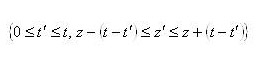
(here t is the observation time expressed in units of length and z the longitudinal coordinate of the observation point) growing with time in both negative and positive z directions. Investigation of the symmetry of the Riemann-Volterra solution in the case of general (circular and non-circular) cylindrical geometry carried out in the article enabled the source term to be continued beyond the waveguide boundary(ies) in such a way that the Riemann-Volterra formula yields a desired solution to the problem within the waveguide, provided that either the Dirichlet or Neumann boundary conditions are imposed.
For simplicity, the investigation is focused on the important case of elliptic waveguides, for the first time providing general solution in terms of the Mathieu modes to the initial-boundary value problem involving the inhomogeneous wave equation with arbitrary source term and initial conditions. More general results can be obtained for general cylindrical waveguides combining the Riemann-Volterra approach with the contemporary techniques of transverse–longitudinal wave decomposition.