 Advances in Engineering Advances in Engineering features breaking research judged by Advances in Engineering advisory team to be of key importance in the Engineering field. Papers are selected from over 10,000 published each week from most peer reviewed journals.

Significance Statement
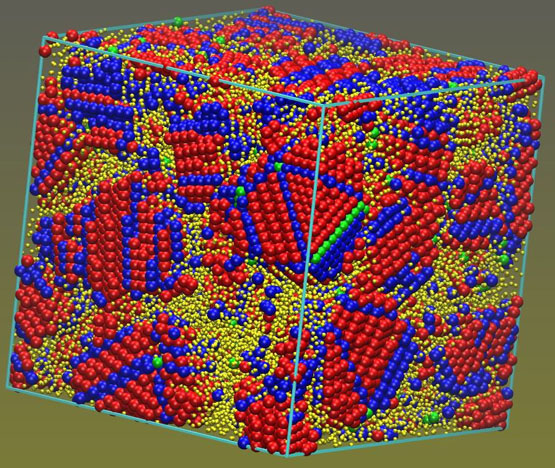
Packing of objects, molecules and particles is of paramount importance in numerous physical, chemical, biological processes and phenomena in daily life. Various factors affect the phase behavior of atomistic systems in the bulk and at interfaces: among others the type of interactions between the various chemical species, the imposed holonomic constraints and the processing conditions. Proper adjustment of such factors at the molecular level could ideally lead to the design of end-materials with tailored phase behavior and thus with advanced structural and mechanical characteristics. Thus, it is not surprising that there has been an ever-growing scientific interest in studying crystallization in atomic and particulate systems. In spite of the significant discoveries and pioneering advances over the recent years, the molecular mechanisms behind crystal nucleation and growth remain rather poorly understood even for the simplest possible molecular model, that of hard spheres. Evidently, the phenomenon becomes a lot more complicated in systems consisting of entities with complex shapes, with a size distribution or in the presence of spatial constraints. Polymers constitute a prominent class of such systems given that they are characterized by a very large spectrum of time and length scales, and by topological constraints which provide them with unique rheological and mechanical properties. In this work we present results from extensive Monte Carlo simulations, on the order of trillions (1012) steps, on how bond tangency and bond gaps affect the crystallization of hard-sphere chains with respect to monomeric analogues. Through simple geometric arguments we show that for the formation of crystallographically perfect face center cubic (fcc) and hexagonal close packed (hcp) crystals, bond constraints, imposed by chain connectivity, lead to a local environment which has to be radially and orientationally symmetric and densely packed. Near the melting transition such a condition cannot be fulfilled as the average contact network is sparsely populated. Thus, bond tangency and connectivity constraints, in general, hinder or even prevent crystallization of polymers at intermediate volume fractions. In parallel, established ordered morphologies seem to be significantly affected by the extent of the applied spatial constraints with the ones obtained for large bond gaps deviating markedly from the ones in the tangent limit. Proper tuning of the contact network can efficiently control phase behavior. The observed trends are not limited to polymeric systems but can be applied to general particulate or atomic systems bearing any type of spatial constraints between the constituent entities.
Journal Reference
Soft Matter. 2015 Mar 7;11(9):1688-700. Karayiannis NCh, Foteinopoulou K, Laso M.
Institute of Optoelectronics and Microsystems (ISOM) and ETSII, Polytechnic University of Madrid (UPM), Madrid, 28028, Spain. [email protected].
Abstract
We report results from Monte Carlo simulations on dense packings of linear, freely-jointed chains of hard spheres of uniform size. In contrast to our past studies where bonded spheres along the chain backbone were tangent, in the present work a finite tolerance in the bond is allowed. Bond lengths are allowed to fluctuate in the interval [σ, σ + dl], where σ is the sphere diameter. We find that bond tolerance affects the phase behaviour of hard-sphere chains, especially in the close vicinity of the melting transition. First, a critical dl(crit) exists marking the threshold for crystallization, whose value decreases with increasing volume fraction. Second, bond gaps enhance the onset of phase transition by accelerating crystal nucleation and growth. Finally, bond tolerance has an effect on crystal morphologies: in the tangent limit the majority of structures correspond to stack-faulted random hexagonal close packing (rhcp). However, as bond tolerance increases a wealth of diverse structures can be observed: from single fcc (or hcp) crystallites to random hcp/fcc stackings with multiple directions. By extending the simulations over trillions of MC steps (10(12)) we are able to observe crystal-crystal transitions and perfection even for entangled polymer chains in accordance to the Ostwald’s rule of stages in crystal polymorphism. Through simple geometric arguments we explain how the presence of rigid or flexible constraints affects crystallization in general atomic and particulate systems. Based on the present results, it can be concluded that proper tuning of bond gaps and of the connectivity network can be a controlling factor for the phase behaviour of model, polymer-based colloidal and granular systems.