Advances in Engineering Advances in Engineering features breaking research judged by Advances in Engineering advisory team to be of key importance in the Engineering field. Papers are selected from over 10,000 published each week from most peer reviewed journals.

International Journal of Thermophysics, January 2014, Volume 35, Issue 1, pp 76-89.
L. Qiu, Y. M. Li, X. H. Zheng, J. Zhu, D. W. Tang, J. Q. Wu, C. H. Xu.
Institute of Engineering Thermophysics, Chinese Academy of Sciences, Beijing , 100190, People’s Republic of China and
Institute of Chemistry, Chinese Academy of Sciences, Beijing , 100190, People’s Republic of China and
Graduate University of Chinese Academy of Sciences, Beijing , 100049, People’s Republic of China.
Abstract
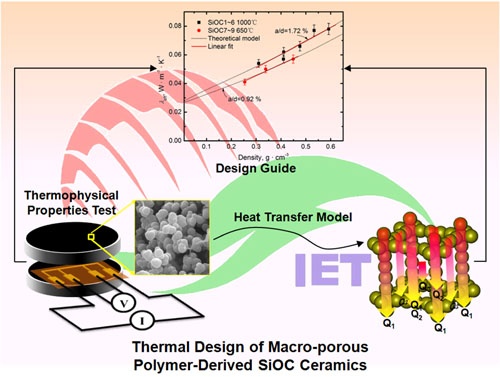
A three-dimensional reticular macro-porous SiOC ceramics structure, made of spherical agglomerates, has been thermally characterized using a freestanding sensor-based 3ω method. The effective thermal conductivity of the macro-porous SiOC ceramics, including the effects of voids, is found to be 0.041 W⋅ m−1⋅ K−1 to 0.078 W⋅ m−1⋅ K−1 at room temperature, comparable with that of alumina aerogel or carbon aerogel. These results suggest that SiOC ceramics hold great promise as a thermal insulation material for use at high temperatures. The measured results further reveal that the effective thermal conductivity is limited by the low solid-phase volume fraction for the SiOC series processed at the same conditions. For SiOC ceramics processed under different pyrolysis temperatures, the contact condition between neighboring particles in the SiOC networks is another key factor influencing the effective thermal conductivity.