Advances in Engineering Advances in Engineering features breaking research judged by Advances in Engineering advisory team to be of key importance in the Engineering field. Papers are selected from over 10,000 published each week from most peer reviewed journals.

Significance Statement
Cast iron foundries spend as much as 25 % of the production cost on power for melting, so any reduction for the required melt for casting is a significant cost reduction and a good business case.
Dimensional stability is of increasing importance for the foundries as precision in casting reduces energy consumption, production cost, and the need for machining. As casting requirements and complexity increases it drives the need for improved production and quality control.
The thermal fields created by the feeders during casting influence the dimensional stability of ductile cast iron, hence the choice of feeder solution and general casting design significantly influence the variability of the produced goods. The silicon (Si) content through its influence on the pearlite formation plays an important role in reducing dimensional variations of cast iron products.
Additionally, this article also shows the potential for using the surface quality control measurements for identifying porosities as a function of surface deformations. This can be a significant new tool for identifying porosity defects as part of a dimensional quality control and enable detection of porosities in locations hidden from ultrasound and x-ray analysis.
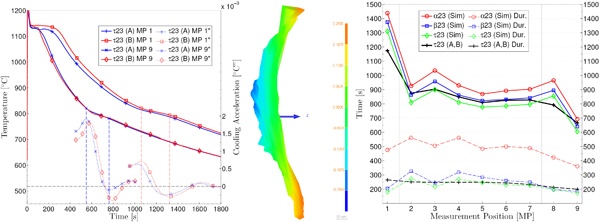
Figure Legend
Left: Cooling curve analysis of the measurement positions.
Centre: Measured deformation of one of the castings.
Right: Phase transformation analysis showing time and duration.
Journal Reference
N.K. Vedel-Smith, J. Rasmussen, N.S. Tiedje. Journal of Materials Processing Technology, Volume 217, 2015, Pages 262–271.
Technical University of Denmark, Department of Mechanical Engineering, Produktionstorvet, Building 427A, DK-2800 Kgs Lyngby, Denmark.
Abstract
A disc-shaped casting with an inner boss and an outer rim, separated by a thin walled section, was examined. This measurable deformation varied with the feeding modulus. The influence of alloy composition, particularly Si content, was examined with a pearlitic ductile iron (EN-GJS-500-7) and a fully ferritic ductile iron (EN-GJS-450-10).
The experiment showed that both the alloy composition and choice of feeder influenced the degree of deformation measured in the finished casting. It was found that the deformation of the pearlitic alloy was influenced controllably by changing the feeder modulus, whereas the deformation of the fully ferritic alloy was less affected by a change in thermal gradient. Both alloys underwent comparable deformations with respect to size, shape, and location.
Go To Journal of Materials Processing Technology