Advances in Engineering Advances in Engineering features breaking research judged by Advances in Engineering advisory team to be of key importance in the Engineering field. Papers are selected from over 10,000 published each week from most peer reviewed journals.

Microelectronics Reliability, Volume 53, Issues 9–11, 2013, Pages 1481-1485.
C. Abbate, F. Iannuzzo, G. Busatto.
Department of Electric and Information Engineering (DIEI), University of Cassino and Southern Lazio, Via G. Di Biasio, 43, 03043 Cassino, FR, Italy
Abstract
The short circuit behaviour of commercial 200 V AlGaN/GaN HFET devices is investigated, clearly evidencing a poor sustainability of such condition. It is observed that, during overcurrent, the drain current tends to increase, exhibiting unstable behaviour. A confirmation of such instability is given by the gate leakage, which also diverges during critical commutations. Measurements evidence a decrease in the threshold voltage at very high temperatures, which is a possible interpretation of the phenomenon.
Some waveforms showing a rupture at 50% of the nominal voltage have been reported, evidencing thermal breakdown in about 2 us.
Additional Information
Gallium-Nitride Heterojunction Field-Effect Transistors (GaN HFETs) are a gushing technology that is going to revolutionise the world of power electronics applications at voltages up to 600V. In fact, in comparison with traditional Silicon power Metal-Oxide-Semiconductor Field-Effect Transistors (MOSFETs) they exhibit lower losses and an unprecedented switching speed –up to several tens of Megahertz, that allow to shrink power supplies up to a factor of two.
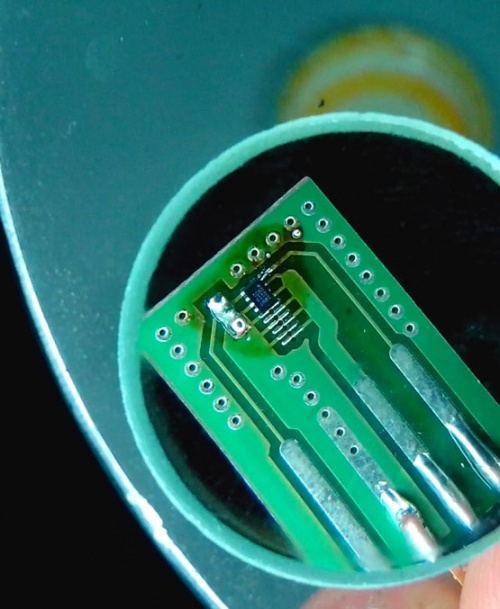
Present limitations of GaN HFET technology are mostly in terms of reliability, because application developers have weak confidence about the endurance level of such transistors. One pro is that, to minimize stray inductance, a flip-chip technique is adopted to connect the semiconductor die directly to the printed-circuit board (PCB) with no package, hence bond wires, which are largely used in Silicon devices and result considerably prone to fatigue and rupture. One con is that power dissipation is limited by the PCB itself, that acts as heat sink as well, and provokes larger temperature swings with respect to hugely-diffused metal packages.
Among the several requirements in terms of reliability, one of the major stressful for a semiconductor power device is short-circuit withstanding. What happens if you accidentally short circuit your laptop power supply outlet with a clip? Would you be happy of getting a scaring explosion? Of course not. For this reason, modern power devices must hold out for a time of 10 microseconds in full short circuit conditions. This is the standard required time for sensing circuits to intervene and to shut down the power safely.
GaN HFETs demonstrated a good behaviour under short circuit, but some possible critical conditions can trigger a disastrous thermal runaway that destroys the device in times of about 2 microseconds. A thermal instability is evidenced in this study, which arises from a reverse trend in the gate threshold voltage at very high temperatures.