Advances in Engineering Advances in Engineering features breaking research judged by Advances in Engineering advisory team to be of key importance in the Engineering field. Papers are selected from over 10,000 published each week from most peer reviewed journals.

International Journal of Chemical Reactor, Engineering, Volume 11, Issue 1, P347-352, (2013).
T. Sankarshana, J. Soujanya, A. Anil Kumar.
College of Technology, Osmania University, Hyderabad 500007, Andhra Pradesh, India
Abstract
The oxidation reaction of 2-ethyl-1-hexanol with potassium permanganate in the presence and absence of silica-gel-supported phase-transfer catalyst (PTC) in triphasic conditions was studied. In a batch reactor, the performance of the solid-supported catalysts was compared with unsupported catalyst and without the catalyst. The effect of speed of agitation, catalyst concentration, potassium permanganate concentration and temperature on reaction rate was studied. The reaction is found to be in the kinetic regime. The rate of reaction with the catalyst immobilised on the silica gel was less compared to the catalyst without immobilisation. Triphase catalysis with supported PTCs has potential applications in the continuous quest for greener industrial practices
Additional Information:
Two immiscible liquid phases containing reactants, when brought together, the reaction is slow or does not occur at all, because of the inaccessibility of the reactants. By adding a phase transfer catalyst (PTC), the reaction can be made faster. Here the phase transfer catalyst facilitates the transfer of anions from one phase to the other phase, thus giving better yields to the desired products. Taking the example of a reaction between aqueous potassium permanganate and organic alcohol (two liquid phases), by adding a phase transfer catalyst like tetra butyl ammonium bromide (Q+Br–), the permanganate ion from the aqueous phase is transferred into the organic phase where the reaction proceeds between the permanganate ion and alcohol as shown below in the sketch.
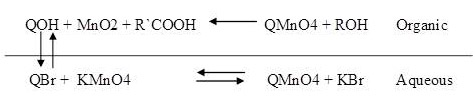
Now the reaction proceeds much faster than without the catalyst. After the completion of the reaction, the removal of the catalyst, present in either or both the phases, though in small quantities is rather difficult and involves considerable cost and effort. Soluble (unsupported) PTCs need to be separated by distillation, adsorption etc. while supported catalysts can be removed by filtration. In comparison withdrawing phase transfer catalysts supported on solids supports is easier and cost-effective.
Due to the presence of a solid catalytic phase in the two liquid phases, the reaction can also be termed a triphasic catalytic reaction. Supported PTCs can be synthesized using different type of supports – organic and inorganic. The materials for the preparation of the organic-supported catalysts are polymers which are very expensive as also are the commercially available polymer supported catalysts. On the other hand, inorganic supports such as silica gel, clay and alumina are relatively much cheaper. However the rates of reactions with catalysts supported on polymers and silica gel are not the same and are lesser compared to the unsupported PTC catalyzed reaction rates. But this is offset by the advantage of simple separation.