Advances in Engineering Advances in Engineering features breaking research judged by Advances in Engineering advisory team to be of key importance in the Engineering field. Papers are selected from over 10,000 published each week from most peer reviewed journals.

Acta Materialia, Volume 61, Issue 20, 2013, Pages 7938-7946.
M. Allart, F. Christien, R. Le Gall.
Institut des Matériaux Jean Rouxel (IMN), Université de Nantes, CNRS, Rue Christian Pauc, Nantes cedex 3, France.
Abstract
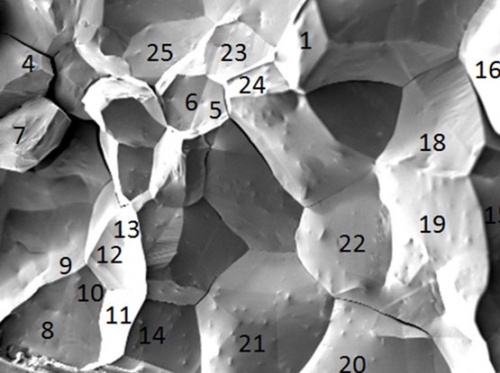
Sulphur grain boundary segregation during hot-compression of nickel (5.4 wt. ppm S) is monitored using Auger electron spectroscopy and wavelength dispersive X-ray spectroscopy. The deformation conditions (temperature/deformation rate) investigated are: 550 °C/0, 550 °C/3 × 10−5 s−1, 550 °C/3 × 10−4 s−1 and 450 °C/3 × 10−5 s−1. It is shown that plastic deformation accelerates the kinetics of sulphur grain boundary segregation by a factor of ∼103 to a few 105, depending on the deformation conditions. Very high levels of segregation (∼0.8 monolayer of sulphur) are obtained after very low deformation (∼5%). In addition a linear dependence of the segregation level with time and deformation is demonstrated. The segregation kinetics during plastic deformation is proportional to the deformation rate and almost independent of temperature. Several metallurgical mechanisms are discussed and confronted with the experimental results: dislocations dragging, pipe diffusion, dislocation collection/diffusion and acceleration by excess vacancies. It appears that the models developed in this work on the basis of the two latter mechanisms (dislocation collection/diffusion and acceleration by excess vacancies) predict the experimental data correctly.