Advances in Engineering Advances in Engineering features breaking research judged by Advances in Engineering advisory team to be of key importance in the Engineering field. Papers are selected from over 10,000 published each week from most peer reviewed journals.

Tanya A. Atanasova, Laureen Carbonell, Rudy Caluwaerts ,Zsolt Tokei, Katrien Strubbe, Philippe M. Vereecken.
Imec, Leuven 3001, Belgium &Department of Inorganic and Physical Chemistry, Gent University, Gent 9000, Belgium &
Centre for Surface Chemistry and Catalysis, KU-Leuven, Leuven 3001, Belgium.
Abstract
The copper interconnect technology is constrained by the significant current distribution due to the terminal effect for resistive thin seeds. As a result, the current in the wafer center can become insufficient for cathodic protection of thin copper seeds leading to center seed corrosion. To improve the current distribution, the exchange current density can be lowered e.g. by lowering the copper concentration. Our approach is to investigate and develop acid ultra-low copper baths with feature fill capability. For this goal, the optimum additives concentrations were sought and fill studies in 30 nm trenches were performed. In addition, proposing a high acid chemistry that is also compatible with direct plating, would enable the in-situ copper seed formation and filling in one and the same process step for direct plating on non-copper seed.
Additional Information
Ultra-low copper acid bath, i.e. 0.01 mol.l-1 CuSO4 + 1.8 mol.l-1 H2SO4, was developed to address issues with terminal effect and to provide with void-free filling of sub-35 nm interconnects. Besides, additional baths with even lower concentration of cupric sulfate or sulfuric acid, such as 0.001 mol.l-1 CuSO4 or 0.018 mol.l-1 H2SO4, were considered.
Electrochemical study of the additives was performed where the normalized charge was used to evaluate the superfilling potential of the additives. The most suitable bath composition was found for both commercial and model additives. The table summarizes the optimum concentrations of bath components in the proposed in this study ultra-low copper baths providing also a comparison between these baths and the conventional plating chemistries. It was shown that further tuning of the additives and chloride ions concentrations is needed when changing the amount of CuSO4 or H2SO4 (see also the table).
Table. Most suitable concentrations of the components in conventional plating baths and in the proposed in this study ultra-low copper baths.
Component/amount | Typical plating baths | Ultra-low copper baths | |
| Cupric sulfate, CuSO4 | 0.25-1.00 mol.l-1 | 0.01 mol.l-1 | 0.001 mol.l-1 |
| Acid, H2SO4 | 0.1-2.0 mol.l-1 | 0.018, 1.8 mol.l-1 | 0.018, 1.8 mol.l-1 |
| Chloride ions, HCl | 20-100 ppm | 10 ppm | 2-5 ppm |
| Suppressor, PEG | 100-500 ppm | 100-500 ppm | 100-500 ppm |
| Accelerator, SPS | 10-100 ppm | 1-10 ppm | 0.5-1.0 ppm |
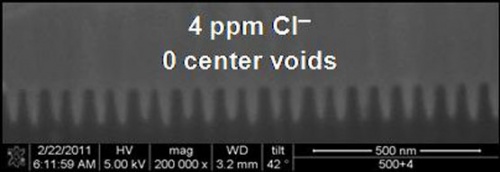
Filling of 30 nm wide trenches (AR 2.7) was conducted where void-free filling was achieved for both 0.01 mol.l-1 CuSO4 and 0.001 mol.l-1 CuSO4. Most importantly, the percentage voids was calibrated for both deposition current and rotation rate enabling establishment of process windows.
This work is a subject of a United States Patent Application No. 20120097547:
Title: Method for Copper Electrodeposition
Abstract: The present invention is related to a method for electroplating a copper deposit onto a substrate, wherein the method comprises the steps of: a) immersing the substrate into an electroplating bath having a copper ion concentration comprised between 0.5 mmol·l−1 and 50 mmol·l−1, and an acid concentration comprised between 0.05% and 10% per volume of said electroplating bath; and wherein the method further comprises the step of b) electroplating the copper deposit from the electroplating bath onto the substrate. In particular, the present invention is directed to an improved method for the manufacture of semiconductor integrated circuit (IC) devices provided with sub-100 nm features.
Application Number: 12/911260
Publication Date: 04/26/2012
Filing Date: 10/25/2010