Advances in Engineering Advances in Engineering features breaking research judged by Advances in Engineering advisory team to be of key importance in the Engineering field. Papers are selected from over 10,000 published each week from most peer reviewed journals.

Appl. Phys. Lett. 103, 113903 (2013);
Shigeyuki Takagi, Tamio Ikeshoji, Motoaki Matsuo, Toyoto Sato, Hiroyuki Saitoh, Katsutoshi Aoki, Shin-ichi Orimo.
Institute for Materials Research, Tohoku University, Sendai 980-8577, Japan and
Quantum Beam Science Directorate, Japan Atomic Energy Agency, Hyogo 679-5148, Japan and
WPI-Advanced Institute for Materials Research, Tohoku University, Sendai 980-8577, Japan.
Abstract
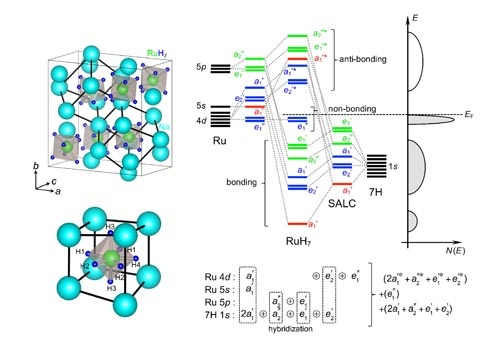
We used density-functional calculations to clarify the origin of the unusual sevenfold coordination of Ru by H in Na3RuH7. We found that the D5h symmetry of the ligands enables the formation of strong covalent bonds of Ru and H through ligand-field effects, stabilizing the sevenfold coordination. We also examined the possible synthesis of the hypothetical 3d analog, Li3FeH7, which has a gravimetric hydrogen density of 8.4 mass%. The calculated enthalpy change of −16 kJ/mol H2 for the reaction,3LiH+Fe+2H2→Li3FeH7, reveals a possible route to a stable complex hydride containing [FeH7]3–.
Additional Information
Although the transition-metal elements T that belong to group 8 in the periodic table, i.e., Fe, Ru, and Os, are known to primarily form [TH6]4– units, which are referred to as complex anions, with octahedrally coordinating hydrogen atoms, Bronger et al. have reported the formation of pentagonal bipyramidal [TH7]3– anions in Na3RuH7 and Na3OsH7. These materials are of scientifically intriguing because of the unusual sevenfold coordination of the transition-metal atom that is expected to result from the specific electronic interactions of the transition metal and hydrogen atoms.
Besides the scientific interest, there is also a technological interest that Na3RuH7 has a high gravimetric hydrogen density (4.0 mass%), even though it contains a 4d transition-metal element Ru; thus, it would be interesting to synthesize 3d analogs in terms of hydrogen storage. If the hypothetical 3d analog containing the lightest alkali metal element in place of Na, i.e., Li3FeH7, can be generated, its gravimetric hydrogen density reaches a value approximately twice that of Na3RuH7 (8.4 mass%), and comparable to that of hydrides with complex anions composed of lightweight nontransition-metal elements, such as alanates. In addition, the gravimetric hydrogen density would be the highest ever reported for complex hydrides containing complex anions composed of the abundant element, Fe.
In this context, we used density-functional calculations to clarify the origin of the unusual sevenfold coordination of Ru by H in Na3RuH7. We found that the D5h symmetry of the ligands enables the formation of strong covalent bonds of Ru and H through ligand-field effects, stabilizing the sevenfold coordination. We also examined the possible synthesis of the hypothetical 3d analog, Li3FeH7. The calculated enthalpy change of -16 kJ/mol H2 for the reaction, 3LiH+Fe+2H2→Li3FeH7, reveals a possible route to a stable complex hydride containing [FeH7]3–.