Advances in Engineering Advances in Engineering features breaking research judged by Advances in Engineering advisory team to be of key importance in the Engineering field. Papers are selected from over 10,000 published each week from most peer reviewed journals.

Color Research & Application, Volume 38, Issue 3, pages 188–195, June 2013.
Michael H. Brill, Marc Mahy .
Datacolor, Lawrenceville, NJ &
Agfa-Graphics N.V., Mortsel, Belgium
Abstract
It has been reported that CIECAM02, the appearance model standardized by the CIE to be used for imaging applications, contains a number of mathematical inconsistencies. These shortcomings cannot be solved easily without changing the behavior of the model and hence a fundamental redesign seems to be needed. At the moment, the main problems with CIECAM02 are known, but there is no clear strategy yet to fix the model. To have an idea about the impact of the inconsistencies of the currently standardized CIECAM02 model and several proposed corrections, the shortcomings are visualized for a number of color/illuminant combinations. From this visualization, a practical and natural approach is obtained to adjust the model without changing the mathematics drastically. © 2011 Wiley Periodicals, Inc. Col Res Appl, 38, 188–195, 2013.
Copyright © 2012 Wiley Periodicals, Inc
Additional Information:
CIECAM02 is the preferred color space used by color-management systems to connect source and destination device profiles. The intent of CIECAM02 was to accommodate different viewing circumstances for looking at the source versus destination device—e.g., different states of chromatic adaptation (parameterized by the chromaticity of the prevailing illuminant). Color management maps a source-device color (e.g., from a display) to CIECAM02 by applying the bit-to-light profile of the display and the chromatic adaptation of the source-device viewer. From CIECAM02, the corresponding color to be rendered by the destination device (e.g., a printer) is determined by inverting the chromatic adaptation of the destination-device viewer and also the bit-to-light profile of that device. In the course of color-management application, the use of CIECAM02 produced disappointment through imaginary and not-a-number results. There were also some surprising reversals of the predictions relative to what is expected in vision. For example, whereas adapting to a purple light should make saturated purple test colors look less purple, CIECAM02 predicts the reverse.
The present article is a vehicle for visualizing, understanding, and finally correcting such incongruities.
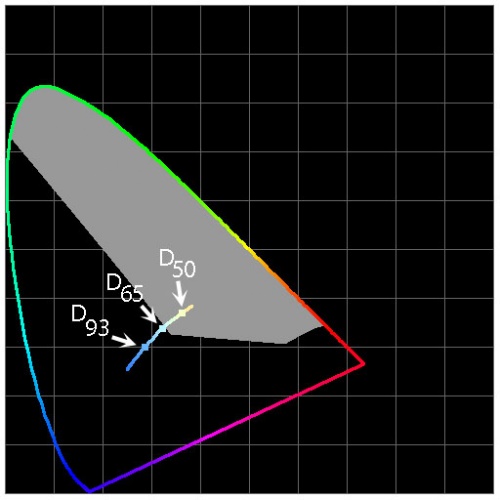
An example of the visualization tool is presented in the xy-chromaticity diagram below. The grey region in represents conventional illuminants for which all real colors (within the horseshoe-shaped spectrum locus) can be converted to CIECAM02 color values. The curve inside the spectrum locus represents the daylight illuminants from 4000 K to 25000 K. The diagram shows that for D50, CIECAM02 converts any real color; however, for D65 and D93 there are some colors that cannot be processed by CIECAM02.
When CIECAM02 is remedied as suggested in the article, the result is a much improved performance. The model as modified in the article is being used by the International Color Consortium in ICCLabs. One investigator wrote to us, “Just wanted to let you both know that I have been testing using the revised model in my digital photography workflow applications and am seeing a significant improvement in the reproduction, behavior, and gamut mapping of dark colors without any visible tradeoff elsewhere (corresponding colors). Looks good!”
Figure Caption: xy-chromaticity diagram, representing in gray the illuminants for which all real colors result in positive R’G’B’ values within CIECAM02.