J. Electrochem. Soc. 2013 160(10):F1143-F1150;Christopher Bonino, Javier Concepcion, James Trainham, Thomas Meyer, John Newman.
RTI International &
The University of North Carolina at Chapel Hill
Abstract
[Ru(Mebimpy)(bpy)OH
2]
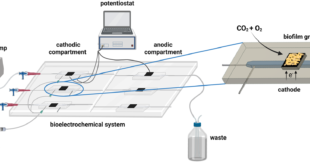
2+[Mebimpy=2,6-bis(1-methylbenzimidazol-2-yl)pyridine; bpy =2,2’-bipyridine], a homogeneous molecular catalyst for water oxidation, is examined using an electrochemical flow cell. A homogeneous catalyst can reduce corrosion by operating at near-neutral pH and is easy to replace when degraded. Traditional alkaline electrolyzers are not free of these issues. The electrochemical flow cell, which is based on a fuel-cell design, includes a zero-gap configuration to minimize ohmic losses. The homogeneous-catalyst kinetics is elucidated by means of electrochemical methods, including Tafel plots. Current efficiencies are measured from the evolved gases. Relationships between catalyst performance and concentration, and anode material are discussed.
© 2013 ECS – The Electrochemical Society
Go To Journal

 Advances in Engineering Advances in Engineering features breaking research judged by Advances in Engineering advisory team to be of key importance in the Engineering field. Papers are selected from over 10,000 published each week from most peer reviewed journals.